
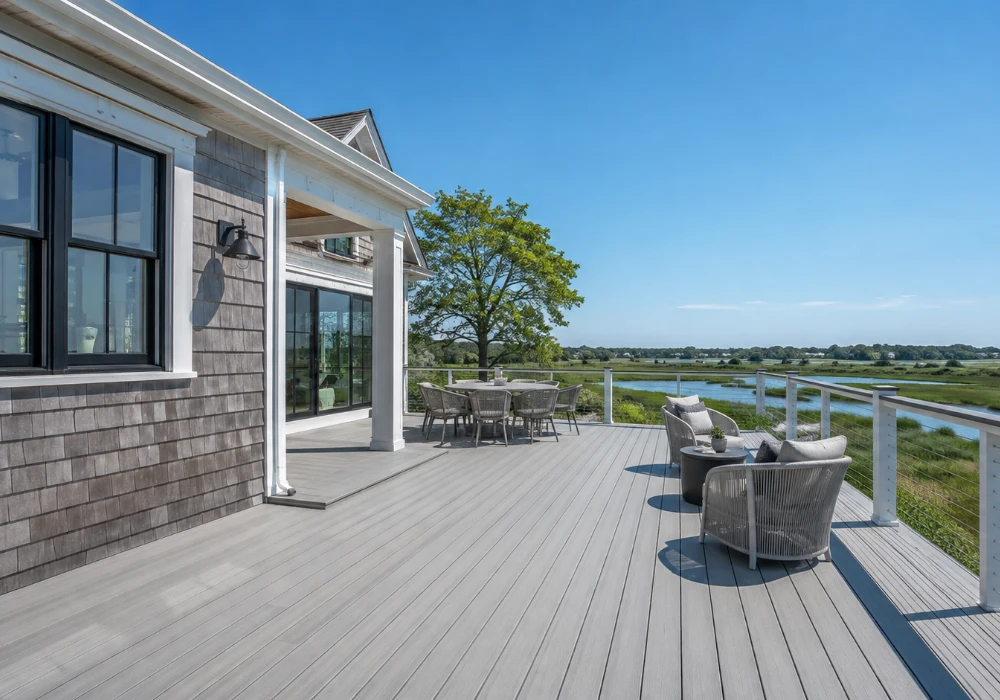
West Harwich sits along the Herring River and its surrounding tidal marsh, a setting that gives the neighborhood its character but also creates a moisture environment that a standard deck build does not account for. This is a different challenge from the open-water wind and salt exposure that shapes deck projects closer to the harbor in Harwich Port, which our Harwich Port custom decks guide covers in detail. Marsh-adjacent moisture behaves differently than open-water spray, and it asks something different of framing, fasteners, and decking material.
Marsh air carries sustained, ambient humidity rather than the intermittent salt spray of an open-water lot. Where a harborfront deck deals with periodic exposure to wind-driven salt, a marsh-adjacent deck in West Harwich sits in a more consistently humid microclimate for much of the year, particularly on lots close to the river or within the tidal marsh buffer. That consistency is what makes marsh exposure a different engineering problem than open-water exposure, even though both fall under the broader category of coastal conditions on Cape Cod.
Framing and Fastener Corrosion in Sustained Humidity
Wood framing and standard fasteners exposed to sustained ambient humidity over long periods are more prone to the kind of slow corrosion and moisture uptake that shortens a deck’s service life, even without direct exposure to standing water or salt spray. In a marsh-adjacent setting, this means fastener selection and framing material matter as much as they do in a more obviously harsh coastal environment, even though the exposure pattern looks different day to day. Corrosion-resistant fastener specification and framing components suited to sustained humidity exposure are the baseline for a West Harwich marsh-adjacent deck build, rather than an upgrade reserved for the most extreme coastal lots.
Decking Material Choices for Ambient Moisture Exposure
Decking material selection matters as much in a marsh-adjacent humidity environment as it does on an open-water lot, though for a related reason. Wood decking in a sustained-humidity setting is prone to the kind of surface checking and moisture-driven degradation that comes from continuous ambient exposure rather than any single weather event. PVC decking, because it does not have a wood fiber component to absorb ambient moisture, does not carry that same vulnerability, which makes it a relevant consideration for West Harwich homeowners whose lots sit close to the marsh and river.
Post Base and Footing Considerations Near the Marsh
Post bases and footings on marsh-adjacent lots benefit from drainage detailing that keeps standing moisture away from the post-to-footing connection, since a humid, low-drainage setting near the marsh does not clear moisture from the base of a post as quickly as a well-drained inland lot would. Positive-drainage post base hardware that keeps the base plate elevated above grade reduces the amount of time moisture sits in contact with the connection, which matters more on a marsh-adjacent lot than it would on a dry, elevated inland property.
How This Compares to Harwich Port and the Rest of Harwich
Harwich already has deck work addressed through our Harwich Port guide, which is built around open-water exposure, code compliance, and entertaining-focused design. West Harwich’s marsh proximity is a distinct condition within the same town, and homeowners in this part of Harwich should not assume that a deck specification built for the harbor side of town automatically applies to a marsh-adjacent lot. If you are also considering siding work elsewhere on your Harwich property, our Harwich siding replacement guide covers how coastal exposure shapes that decision as well. Homeowners on the Dennis side of this same marsh and river system may also find relevant context in our Dennis micro-climate exterior guide, which addresses how exposure direction changes exterior material decisions on a lot-by-lot basis.
Frequently Asked Questions (FAQ)
Is a marsh-adjacent deck in West Harwich really a different build than a deck closer to Harwich Port?
Yes, though the difference is in the type of moisture exposure rather than the overall severity. As covered above, a marsh-adjacent lot deals with sustained ambient humidity, while an open-water lot deals more with wind-driven salt spray. Both require careful material and fastener selection, but the specifics differ, which is why we assess each lot individually rather than applying one standard specification across all of Harwich.
Do I need PVC decking on a marsh-adjacent lot, or is wood still an option?
Wood decking remains an option, but as described above, it is more prone to surface checking and moisture-driven degradation in a sustained-humidity environment. Homeowners who want to minimize long-term maintenance on a marsh-adjacent lot often choose PVC decking for this reason, though the final decision depends on your priorities and budget.
How do I know if my West Harwich lot is close enough to the marsh to need this extra attention?
Proximity to the Herring River and the surrounding tidal marsh buffer is the main factor, along with how consistently humid the area around your deck feels compared to other parts of your property. We assess site conditions directly during a consultation rather than relying on distance alone, since marsh influence can vary lot to lot.
Can my existing deck framing be inspected before I decide on full replacement?
Yes. We evaluate framing, fasteners, and post base connections individually to determine whether repair and partial upgrades are sufficient or whether full replacement is the more reliable path forward, particularly on marsh-adjacent lots where moisture-driven wear is not always visible from the surface.
Request a Free Project Review at (774) 338-6234 or visit roofinglions.com to schedule your complimentary West Harwich deck consultation.