
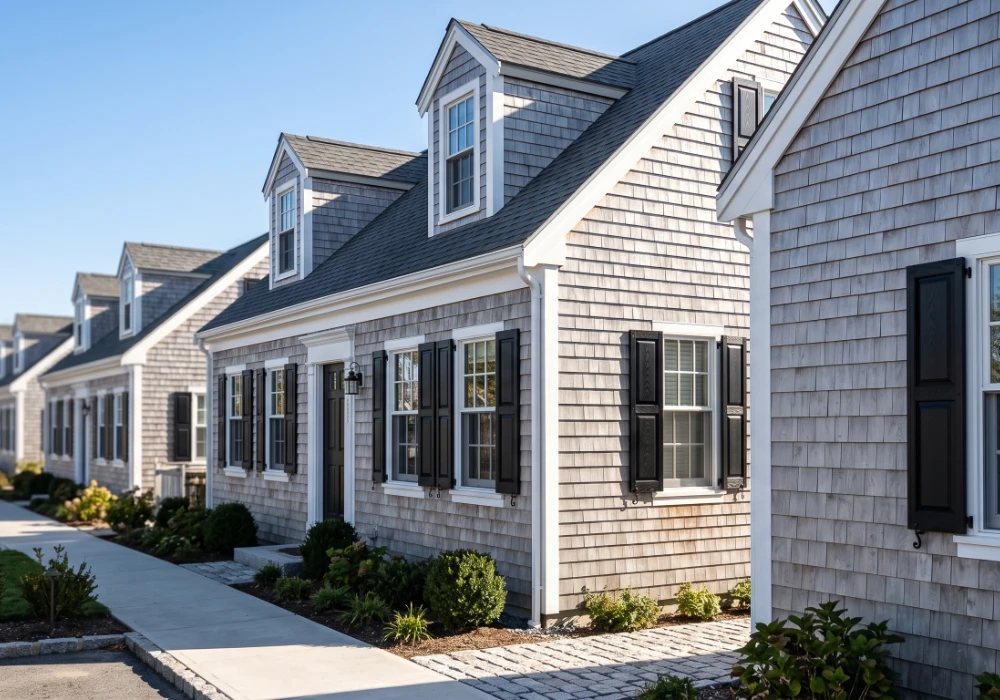
Harwich’s village center, along the Route 39 corridor and the older residential streets surrounding it, holds a different housing stock than the waterfront properties most commonly associated with Cape Cod exterior work. These are smaller-scale, cottage-style homes, many built decades ago and maintained through a long history of incremental repairs rather than full exterior replacements. That repair history is exactly what creates the siding problem this guide addresses.
Harwich Village Center: A Different Housing Stock Than the Waterfront
Unlike the larger waterfront homes that dominate discussions of coastal siding performance, Harwich’s village-center cottages were typically built to a modest original scale and have been added onto, patched, and repaired multiple times over their service life. Each repair cycle often introduced a slightly different siding material or profile than what was originally installed, since matching decades-old material exactly is rarely possible by the time a repair becomes necessary. The cumulative result, visible on many Harwich village homes today, is an exterior that reads as a patchwork of materials rather than a single cohesive envelope.
The Patchwork Problem: Decades of Partial Repairs
A siding repair addresses the immediate problem, whether that is a section of rot, storm damage, or a failed board, but it rarely addresses the underlying reason that section failed in the first place. When repairs accumulate over ten or twenty years without a full replacement, a home ends up with multiple siding materials, multiple installation eras, and multiple points where water can find its way behind the exterior envelope through gaps between mismatched materials that were never designed to interlock with each other. This is a distinct problem from the storm damage or coastal wind exposure that drives most siding replacement decisions elsewhere on the Cape, and it requires a different diagnostic approach.
Why Material Continuity Matters More Than Any Single Repair
The core issue with a patchwork exterior is not the appearance, although that matters to homeowners. It is that a discontinuous siding envelope creates multiple weak points where moisture can penetrate behind the exterior cladding, each one independent of the others and each one capable of causing hidden rot in the wall assembly long before any visible symptom appears on the surface. A full siding replacement resolves this by installing a single continuous material and installation system across the entire home, eliminating every transition point that a decades-long patchwork repair history has introduced.
For Harwich homeowners uncertain whether hidden rot may already be present behind a patchwork exterior, reviewing the warning signs is a useful first step before committing to a full siding scope.
Fiber Cement as the Long-Term Answer for Cottage-Style Homes
- Consistent profile across the full home: Fiber cement siding is manufactured to a consistent profile and dimension, which eliminates the variation in board width, reveal, and texture that accumulates when a home has been repaired with whatever material was available at the time.
- Moisture resistance suited to Cape Cod’s climate: Fiber cement does not absorb ambient moisture the way that untreated or aging wood siding does, which addresses the underlying vulnerability that likely caused the original repairs a patchwork home has accumulated over the years.
- Compatibility with cottage-style architectural details: Fiber cement siding is available in profiles that maintain the traditional cottage look common to Harwich’s village-center homes, so a full replacement does not require sacrificing the architectural character that gives these streets their appeal.
Homeowners weighing the same wood-to-fiber-cement transition can find additional detail in our Dennis Siding Replacement guide, which covers this material upgrade for a neighboring Cape town facing a similar decision.
Coordinating Siding With Trim and Roofline Details
A full siding replacement is also the right moment to address trim inconsistencies that often accumulate alongside a patchwork siding history. Fascia, corner boards, and window trim frequently show the same mismatched-repair pattern as the siding itself, since these elements are typically touched during the same repair cycles that introduced siding variation. Addressing trim and siding together as a single project, rather than treating them as separate future repairs, produces the unified exterior envelope that a patchwork history has prevented for years.
Our Centerville Siding & Trim guide covers this same coordination challenge for another Cape town where mismatched exterior materials had accumulated over time, and is a useful companion reference for Harwich homeowners planning a similar full-envelope approach.
Frequently Asked Questions (FAQ)
How do I know if my Harwich home’s siding history counts as a patchwork problem?
If you can identify visibly different siding materials, board widths, or textures across different sections of your home’s exterior, or if you know the home has had multiple siding repairs over the years without a full replacement, this is the patchwork pattern this guide addresses. A visual inspection during a consultation can confirm the extent of the variation and identify any hidden moisture entry points at the transitions between materials.
Is a full siding replacement really necessary, or can the mismatched sections just be repaired again?
Another round of partial repair will likely produce the same result as previous repairs: a temporary fix that does not address the underlying discontinuity in the exterior envelope. A full replacement is the only way to eliminate the multiple weak points that a long repair history has introduced, and it typically proves more cost-effective over time than continuing a cycle of partial repairs.
Will fiber cement siding look out of place on a traditional Harwich cottage?
No. Fiber cement is manufactured in profiles designed to replicate traditional wood siding’s appearance, including the narrow board reveals common to cottage-style architecture. The material upgrade addresses moisture performance without changing the visual character that defines Harwich’s village-center streets.
Should I address my deck or other exterior elements at the same time as siding?
If other exterior elements are due for attention, coordinating the work can reduce disruption and ensure materials and timelines align across the full project. Harwich Port homeowners specifically working through a deck project alongside other exterior work may find our Harwich Port Custom Decks guide useful for understanding how we sequence multi-element exterior projects in the Harwich area.
All Harwich siding projects are permitted through the Harwich Building Department and managed under Lions Siding & Roofing’s Massachusetts licenses (CSL 120645 / HIC 198901).
A patchwork exterior does not resolve itself with one more repair. Request a Free Project Review at (774) 338-6234 or visit roofinglions.com to schedule your complimentary Harwich siding consultation.