
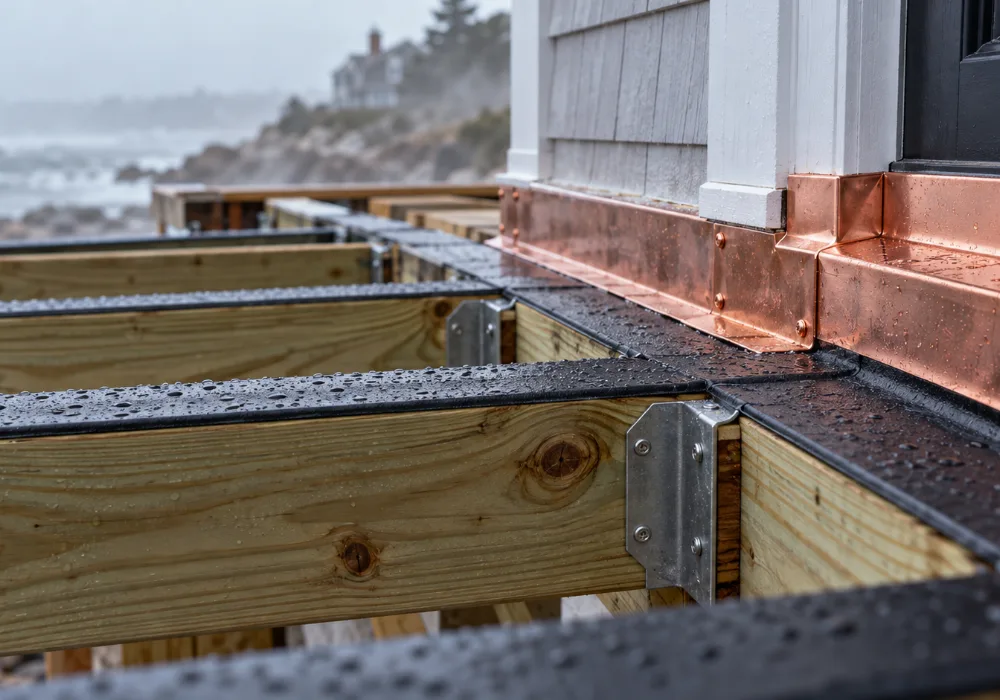
A deck is a system, and Falmouth tests every layer
Falmouth faces Buzzards Bay and Vineyard Sound, so a deck here deals with salt air, moisture, and strong seasonal weather. Homeowners usually judge a deck by its surface, but the surface sits on top of five other layers, and the weakest one decides how long the whole deck lasts. This guide starts underground and works upward, the same way we evaluate a replacement.
If you want to see how another Cape Cod town handles wind exposure on a deck, our South Chatham deck replacement guide is a useful companion to this one.
Layer 1: Footings and posts
Everything rests on the footings. They need to extend below the frost line so winter freezing does not push them upward, and they need enough bearing area to carry the load. A deck that has shifted, tilted, or developed gaps at the house often has a footing problem that no amount of new decking will fix. During a replacement we look at whether existing footings can be reused or whether new ones are the safer choice.
Layer 2: Framing and joists
Joists and beams carry the weight of people, furniture, and snow. Framing that stays damp, especially near the ground or where boards overlap, begins to soften from the underside, where it is hard to see. Pressing a screwdriver into suspect framing is a quick test. Soft areas, dark staining, or crumbling edges mean the structure has aged beyond a surface refresh.
Layer 3: The ledger connection to your house
The ledger is the board that attaches the deck to the house, and it is one of the most important safety details in the entire structure. Water that gets behind it can damage the house framing as well as the deck. Correct flashing above and around the ledger directs water away from that joint. When we replace a deck, the ledger area is inspected closely, and when siding is involved, coordinating the two prevents leaks. Our article on stopping hidden rot where decks meet siding explains why.
Layer 4: Fasteners, connectors, and salt air
Salt air accelerates corrosion on metal. Screws, bolts, joist hangers, and post bases are small parts that carry large responsibilities, and standard hardware can deteriorate faster near the coast. Choosing corrosion-resistant fasteners and connectors suited to the environment is one of the least visible and most valuable decisions in a Falmouth deck. Homeowners who see rust streaks running down posts or beams should treat them as an early warning.
Layer 5: Decking surface
The surface is the layer you see and feel. Many Cape Cod homeowners choose composite or similar low-maintenance boards because they resist rot and need less upkeep than traditional wood. We explored a durable coastal option in our article on TimberTech deck building in Sandwich. When comparing surfaces, consider how much sun the deck receives, whether it stays shaded and damp, and how much maintenance you want to take on.
Layer 6: Railings, stairs, and safety
Railings must be strong enough to resist leaning and pushing, and stairs need consistent steps and solid attachment. Building codes set requirements for guard height, baluster spacing, and stair dimensions, and a replacement is the right moment to bring these details up to current standards. For a project where code and safety took center stage, see our Harwich Port custom decks guide.
Planning your Falmouth deck project
Start by deciding how you plan to use the space. A deck for dining and entertaining has different needs than one for quiet mornings, and the layout, size, and materials follow from that. Because the deck attaches to your home, it also helps to consider how the nearby roof and siding are holding up. If the roof above is due for work, our Falmouth roof replacement guide can help you plan the order of projects. We also recommend contacting us before the busy season so there is time for design, permitting, and scheduling.
Frequently Asked Questions (FAQ)
How do I know if my Falmouth deck needs full replacement?
Soft or rotted framing, a loose ledger, shifted footings, and heavy corrosion on hardware are the main indicators. Surface wear alone can sometimes be addressed by replacing the boards, but structural problems call for a deeper repair.
Can I keep my existing framing and only replace the boards?
Sometimes. If the framing is sound and the footings and ledger pass inspection, new decking can go over the existing structure. We check each layer before recommending that route.
Does a deck replacement require a permit?
Deck work generally involves local building department requirements. We review what applies to your Falmouth property during the project review.
What decking material holds up best near the coast?
Low-maintenance materials such as composite resist rot and reduce upkeep, though the right choice depends on your property, budget, and appearance preferences. We discuss the options during your consultation.
Should I replace the railings at the same time?
Usually, yes. Railings and stairs attach to the same structure, and updating them together keeps the safety details consistent and avoids reopening the deck later.
A deck that lasts depends on every layer doing its job, from the footings to the railings. To have your Falmouth deck evaluated, request a Free Project Review at (774) 338-6234 or visit roofinglions.com.