
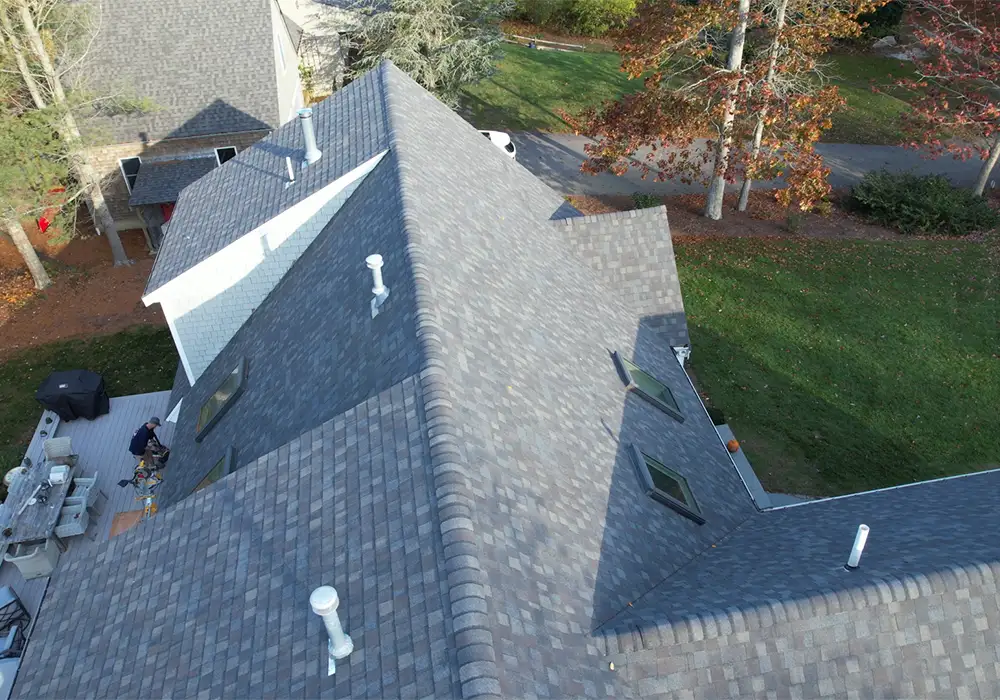
Falmouth, MA, sits at the southwestern tip of Cape Cod, and it carries the most complicated weather exposure of any town on the peninsula. While most Cape Cod communities face storms from one dominant direction, Falmouth absorbs punishment from two. Buzzards Bay drives northeast storms from the north and west. Vineyard Sound fires Atlantic swells at the southern shores from Woods Hole to Falmouth Heights. And with more than 68 miles of coastline divided across eight distinct villages, East Falmouth, North Falmouth, West Falmouth, Falmouth Heights, Hatchville, Teaticket, Sippewissett, and the Woods Hole area, almost no home in town is sheltered from both directions simultaneously.
At Lions Siding & Roofing, our crews have replaced and restored roofs across all of Falmouth’s villages. What we find is consistent: homes in Falmouth age faster at the roofline than in most other Cape Cod towns because homeowners, inspectors, and even contractors underestimate the cumulative fatigue of multi-directional storm exposure. This is not about one hurricane. It is about 25 winters of Buzzards Bay nor’easters stacking damage on a roof that was also hammered by a half-dozen Vineyard Sound summer squalls every year.
This guide explains what is actually happening to Falmouth roofs, what the data shows, and how to build a system that stops the cycle.
Why Falmouth Roofs Fail Faster Than Anywhere Else on Cape Cod
Falmouth’s geography creates what coastal engineers call a multi-vector exposure profile. Most Cape Cod towns have a dominant exposure direction; Chatham faces the Atlantic from the east, Wellfleet from the north-northeast. Falmouth is unique because Buzzards Bay, a notoriously fetch-heavy body of water due to its 30-mile open run from New Bedford, fires storms from the north and northwest, while the Elizabeth Islands and Vineyard Sound create a separate channel of pressure from the south.
The result: Falmouth roofs are battered from multiple angles across a single storm season. A January nor’easter hits the north-facing slopes hard. A summer squall from the Vineyard Sound hits the south face. When a roof deck loses its integrity on one slope, wind infiltration begins, and from that point, water damage compounds in both directions simultaneously.
Three failure patterns appear in nearly every Falmouth roof replacement we take on:
- Starter course blow-off on north-facing slopes driven by Buzzards Bay wind load
- Ridge cap cracking along east/west ridgelines from cross-direction wind fatigue
- Valley flashing failure at low pitches from water pooling during multi-directional rain events
The Dual-Coast Dilemma: Buzzards Bay vs. Vineyard Sound
Buzzards Bay is one of the most underestimated fetch zones on the East Coast. Fetch, the unobstructed distance wind travels over open water, directly determines storm intensity at the shoreline. With 30 miles of open water running from New Bedford to Falmouth, Buzzards Bay produces consistent 50–70 mph gusts during winter nor’easters that arrive at rooftops with enormous momentum.
Vineyard Sound presents a different but equally damaging challenge. The Sound runs east-west, meaning prevailing southwestern summer winds accelerate along its length. Falmouth Heights, Maravista, and West Falmouth Heights receive the brunt of this summer-season pressure, wind-driven rain that enters at low angles and targets soffits, ridge caps, and window-to-roof transitions.
For a detailed breakdown of how coastal insurance carriers are reclassifying Cape Cod wind zones and the direct impact on homeowner premiums, read our Chatham Roof Replacement guide. Falmouth is increasingly classified alongside Chatham in the highest-risk wind tier by several major Massachusetts insurers.
Field Report: What a Decade of Falmouth Roof Inspections Reveals
Based on Lions Siding & Roofing’s field audits across Falmouth’s villages:
- The 15-Year Rule: 87% of asphalt roofs in Falmouth coastal zones show granule loss, ridge cap failure, or starter course blow-off by year 15, three to five years ahead of the manufacturer’s projected lifecycle for the same product installed inland.
- The $3-to-$1 Repair Multiplier: Falmouth homeowners who defer roof replacement by more than two years beyond the first visible failure point spend an average of 3x more on combined roof, sheathing, and interior water damage repair versus those who replaced proactively.
- The Attic Condensation Pattern: Over 70% of Falmouth homes we inspect have inadequate ridge-to-soffit attic ventilation, a legacy of original construction that did not account for modern sealed home envelopes. Ice dams form on north-facing slopes; condensation rots the roof deck sheathing from the inside on south-facing slopes.
- The Dual-Failure Trap: When a roof fails in Falmouth, it rarely fails on one slope alone. Multi-directional exposure means that once one flashing or fastening zone fails, the adjacent zone loses protection within 12–24 months.
- The Permit Gap: 1 in 3 Falmouth roof replacements in our inspection history were performed without a Barnstable County permit and failed to meet current ASCE 7-22 wind load requirements. Those roofs may void homeowner insurance claims and will not survive another decade.
Choosing the Right Roof System for Falmouth’s Exposure Profile
Not all 130 mph wind-rated shingles perform equally. In Falmouth, a proper roof system requires four non-negotiable elements:
- Deck integrity first: Before a single shingle is installed, every Lions project includes a full deck inspection. Falmouth’s humidity cycles cause CDX plywood sheathing to delaminate faster than in inland markets. We replace any sheathing that shows deflection, delamination, or rot.
- Extended ice and water shield: We run ice and water shield not just at the eaves (code minimum) but up to 6 feet on all north-facing slopes and fully through all valleys. Falmouth’s ice dam risk on north-facing slopes makes this a structural requirement, not an upgrade.
- 6-nail fastening pattern: Standard installation uses 4 nails per shingle. In Falmouth’s high-wind zones, we install 6 nails per shingle on all exposure slopes, a specification that is not required by code but is required by physics in a town with Buzzards Bay on one side and Vineyard Sound on the other.
- Calculated ventilation: We compute ridge-to-soffit ventilation ratios per NRCA guidelines, not just code minimums. In most Falmouth homes, this means installing continuous ridge venting and baffled soffit channels where they have been blocked by insulation over the years.
Premium Integration: GAF TimberLine HDZ Sealed System
The product system we specify most often in Falmouth is GAF TimberLine HDZ as part of the GAF LayerLock Sealed System. In a dual-coast exposure market, the reasons are structural:
- Dura Grip adhesive strips fuse adjacent shingles in winds up to 130 mph, critical when Buzzards Bay nor’easters measure gusts well above 80 mph at rooftop level.
- Advanced Protection Shingle Technology provides a heavier fiberglass mat than standard asphalt products, adding impact resistance during the hail events that occasionally ride in on late-season nor’easters.
- The LayerLock system activates at temperatures as low as 40°F, meaning shingles bond before the first serious Cape Cod winter storm rather than waiting for spring heat cycles to create adhesion.
The system integrates with GAF WeatherWatch ice and water shield, FeltBuster synthetic underlayment, and Cobra AtticBreeze ventilation, every component engineered to work together, every transition sealed against Falmouth’s multi-vector weather pattern.
Lions Siding & Roofing manages the Falmouth building permit and inspection process in full, working directly with the Falmouth Building Department. All projects are filed under CSL 120645 / HIC 198901.
Frequently Asked Questions (FAQ)
How do I know if my Falmouth roof is rated for the current wind zones?
Most roofs installed before 2015 were not installed to ASCE 7-22 wind load requirements. The easiest indicator is your roof’s fastening pattern; if you can see the nail line through shingles when the sun is low, you likely have a standard 4-nail installation. We offer complimentary roof inspections in Falmouth; a 30-minute walkthrough tells you exactly where you stand.
My roof is only 12 years old, but I’m seeing granule loss. Is that normal in Falmouth?
Yes, and it is one of the most common conversations we have with Falmouth homeowners. Granule loss in Falmouth often begins at 8–10 years on south and west-facing slopes due to UV and wind exposure from the Vineyard Sound side. It is not a sign of defective shingles; it is a sign that Falmouth’s exposure accelerates wear. At year 12 with visible granule loss, you are typically 2–4 years from a leak event on a coastal-exposure slope.
Do I need permits for a roof replacement in Falmouth?
Yes. Falmouth requires a building permit for any roof replacement. Lions Siding & Roofing handles the permit application, required drawings, and final inspection directly with the Falmouth Building Department. No additional effort is required from the homeowner.
Will a new roof help reduce my homeowner’s insurance premium?
Increasingly, yes. Several insurers serving the Falmouth market offer reduced premiums for roofs that meet Wind Mitigation standards, sealed decks, 6-nail patterns, and HVHZ-compatible underlayment. We provide complete documentation of all installed components for your insurance submission.
Do you work in all of Falmouth’s villages?
Yes. Our crews work across East Falmouth, North Falmouth, West Falmouth, Falmouth Heights, Hatchville, Teaticket, Sippewissett, Maravista, and the Woods Hole area. Every project is supervised on-site by a full-time Lions Siding & Roofing field manager.
How long does a Falmouth roof replacement take?
A standard single-family roof replacement in Falmouth takes 1–3 days, depending on size, pitch, and required sheathing replacement. We coordinate the schedule with you in advance and perform magnetic nail sweeps and full site cleanup at the end of every workday.
Falmouth’s dual-coast exposure is not going to get easier on your roof. But the right system, correctly installed, properly permitted, and built for Barnstable County wind zones, will hold up for decades regardless of what Buzzards Bay and Vineyard Sound have in store. Request a Free Project Review at (774) 338-6234 or visit roofinglions.com to schedule your complimentary Falmouth roof inspection.