
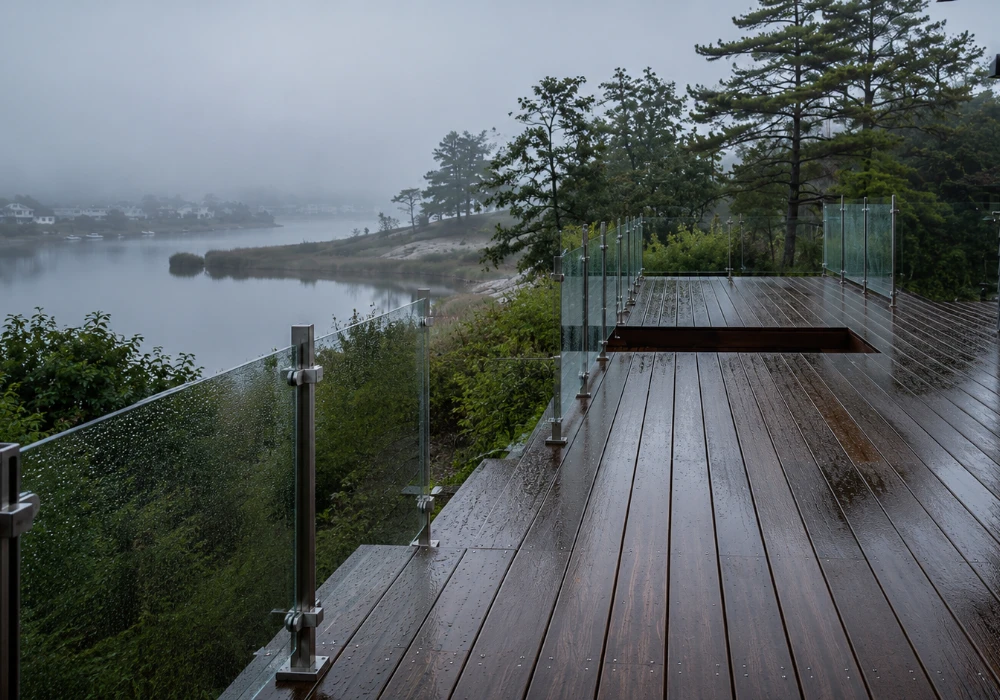
Wellfleet holds two very different waterfront conditions inside one small town: the freshwater kettle ponds scattered through its interior, carved out by retreating glacial ice, and the working harbor and bay shoreline that defines its commercial and recreational identity. A deck built on a kettle pond lot and a deck built near the harbor are answering to two different environmental problems, even though both sit only a few miles apart and both fall under the same town name.
Two Exposures, One Deck: Wellfleet’s Unusual Position
We covered a related version of this problem in our Pembroke pond-lot deck guide, where sandy outwash soil and pond proximity combine to drive frost heave on deck footings. Wellfleet’s kettle pond properties share that same sandy, high-water-table soil profile. The difference is what else the town adds on top of it: harbor-adjacent Wellfleet properties layer in constant salt-air exposure that a purely inland pond town like Pembroke does not experience, and the outer Cape’s sandier, more exposed barrier geology behaves somewhat differently from Pembroke’s inland glacial outwash even where the underlying moisture mechanism is similar.
Kettle Pond Properties: Sandy Soil, High Water Table, No Frost Complication
Wellfleet’s kettle ponds, formed by blocks of glacial ice that melted in place and left behind steep-sided depressions, sit in the same sandy, well-drained soil that defines much of the outer Cape. Properties near these ponds share the elevated water table condition we describe in detail in the Pembroke guide: soil that drains surface water efficiently but still allows capillary moisture to migrate upward toward a deck footing from below. On the outer Cape, this soil moisture condition combines with generally milder, more moderated winter temperatures than inland South Shore towns experience, which changes the balance between frost-driven footing movement and the ongoing settlement pressure that constant subsurface moisture creates on a footing over many years, even outside of the frost season itself.
Harbor-Side Properties: Salt Air and Fastener Corrosion
Decks near Wellfleet Harbor and the bay-facing shoreline face a different primary threat than kettle pond properties: continuous salt-air exposure that accelerates corrosion on every metal component of the deck structure, from post base connectors to joist hangers to the fasteners holding the decking boards themselves. A standard fastener specification, adequate on an inland Wellfleet lot, corrodes measurably faster on a harbor-facing deck, and once a connector’s hold-down capacity is compromised by corrosion, the structural risk is the same as the frost-driven separation we document on Pembroke pond lots, just arrived at by a different mechanism.
Cape Cod National Seashore and Wetland Buffer Considerations
A meaningful share of Wellfleet’s most desirable waterfront and pond-adjacent lots sit near Cape Cod National Seashore boundaries or wetland resource areas regulated by the town’s Conservation Commission. Deck footprint, especially any expansion of an existing deck’s footprint, on these properties often requires a resource area review before a building permit can be issued. We check this proximity as part of every Wellfleet waterfront deck consultation, the same way we do for Pembroke pond-lot projects near the 100-foot buffer zone, so that any required filings are underway before the project timeline depends on it.
Field Report: What a Wellfleet Deck Inspection Reveals
On kettle pond properties, the pattern we find closely mirrors what we document in Pembroke: outer posts with lighter tributary load showing more cumulative upward migration than posts under full beam load, producing the same corner-up tilt over a period of years. On harbor-side properties, the failure signature is different. Rather than footing migration, we find corrosion at post base connectors and joist hangers well ahead of the wood or decking material’s own service life, particularly on decks facing directly into the prevailing salt-air path off the harbor.
Our Footing and Framing Specification for Wellfleet
Because Wellfleet properties fall into two distinct exposure categories, we tailor the specification to the site rather than applying one standard across the whole town:
- Kettle pond lots: Extended footing depth and a gravel drainage collar around each footing, following the same principle we apply on Pembroke pond-lot projects, adjusted for the outer Cape’s milder frost profile.
- Harbor-side lots: Marine-grade, corrosion-resistant post base connectors, joist hangers, and fasteners specified throughout, rather than standard-grade hardware that degrades faster under continuous salt exposure.
- All Wellfleet projects: PVC decking as the standard surface recommendation, since a fully solid PVC product resists both the ambient moisture near kettle ponds and the salt exposure near the harbor without the maintenance burden that pressure-treated wood carries in either environment. Sandwich homeowners considering a similar low-maintenance approach can see our full material comparison in the Sandwich TimberTech deck guide.
For Wellfleet decks requiring a higher entertaining load capacity, such as larger harbor-view decks built for gatherings, the code and safety engineering approach we detail in our Harwich Port custom deck guide applies directly, since both towns require the same load-bearing rigor for decks built to host groups.
Frequently Asked Questions (FAQ)
How do I know if my Wellfleet property is a kettle pond lot or a harbor-exposure lot?
Most Wellfleet properties fall clearly into one category based on proximity to a kettle pond versus the harbor and bay shoreline, but some inland lots sit close enough to both that they need elements of each specification. We assess this directly during the site visit.
Will my deck need Conservation Commission review?
Only if the footprint falls within or near a wetland resource area or Cape Cod National Seashore boundary. We conduct a resource area proximity check on every Wellfleet waterfront consultation before filing the building permit application.
Is PVC decking really necessary, or is pressure-treated wood enough for a Wellfleet property?
Pressure-treated wood will function on a Wellfleet deck, but it requires more frequent maintenance in both the kettle pond humidity environment and the harbor salt-air environment than it would on a less exposed inland Cape property. PVC decking removes that maintenance burden in either exposure.
Wellfleet asks more of a deck than most Cape towns because it asks two different things at once, depending on which side of town a property sits on. Building to the actual exposure, not a generic Cape Cod deck specification, is what keeps a Wellfleet deck level, structurally sound, and low-maintenance across its full service life. Request a Free Project Review at (774) 338-6234 or visit roofinglions.com to schedule your complimentary Wellfleet deck consultation.