
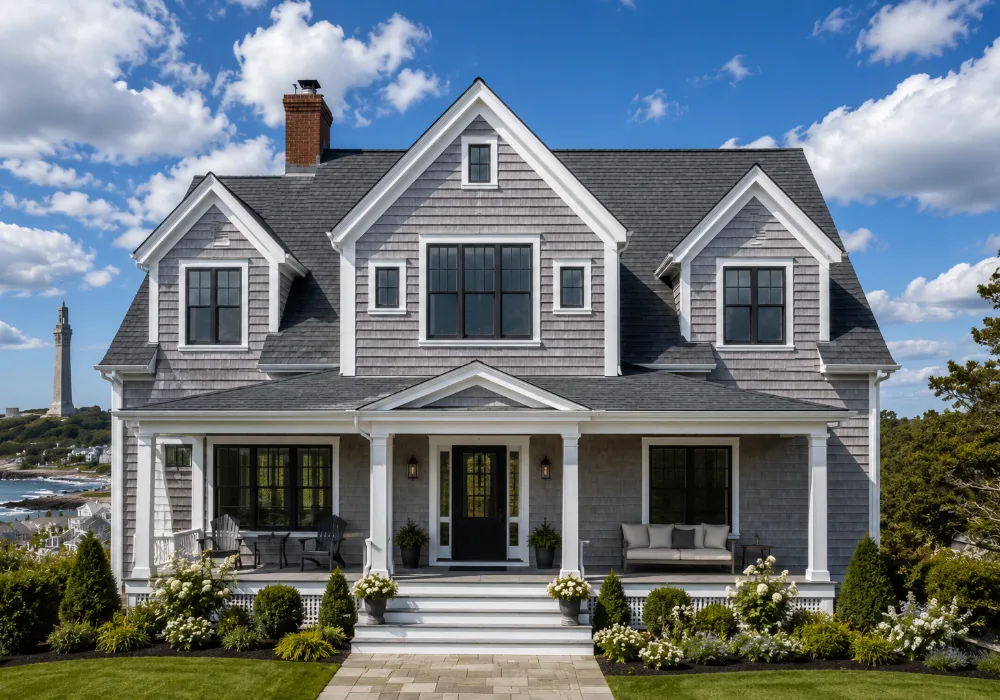
Provincetown sits at the literal end of Cape Cod, a narrow spit of sand with open Atlantic water on one side and Cape Cod Bay on the other, and almost nothing in between to slow the wind down before it reaches a roof. That geography makes reroofing here a different exercise than almost anywhere else on the Cape. It is not a question of picking a shingle color that matches the neighbors. It is a question of whether the roof assembly underneath that shingle can hold on through a winter of nor’easters arriving with nothing to break their approach.
Why Provincetown Roofs Face the Cape’s Most Direct Wind Exposure
Most Cape Cod towns get some benefit from tree cover, dune lines, or simply distance from open water. Provincetown’s built environment, particularly in the West End and around the harbor, sits directly exposed to fetch from two different bodies of water depending on which way the storm is tracking. A roof here does not get a break between weather systems the way an inland Barnstable or Yarmouth roof does. The wind exposure is closer to what we treat as an insurance-driven, high-wind design problem in Chatham, though the underlying cause is different: Chatham’s challenge is largely about qualifying for coastal insurance carriers after a claim history, while Provincetown’s is about a building envelope that simply never gets a wind shadow. Our Chatham high-wind roofing guide covers the insurance side of that equation in detail, and much of the fastening logic carries over directly to Provincetown reroofs.
Unobstructed Exposure: What Wind Loading Looks Like at the Tip of the Cape
Wind uplift on a roof is not simply a function of wind speed. It is a function of wind speed acting on a surface with nothing upstream to disrupt the airflow before it arrives. A roof surrounded by mature trees and other structures experiences turbulent, broken-up airflow that reduces peak uplift forces at any single point. A roof standing at the edge of open water, as most Provincetown properties do, experiences laminar, unbroken wind that generates higher and more consistent uplift pressure across the entire roof plane, and particularly at the edges and corners where uplift force concentrates.
This is the reason a shingle system that performs adequately in a more sheltered Cape town can fail prematurely in Provincetown even when installed correctly to a lower wind-rating standard. The roof edge and corner zones, where uplift pressure is highest, require expanded fastening patterns and starter strip treatment that goes beyond what code minimum requires for less exposed locations.
Reroofing Inside Provincetown’s Historic District: West End to East End
Much of Provincetown’s downtown falls within a historic district where roofline profile, material appearance, and in some cases color are subject to review. Narrow lots and closely spaced structures in the West End and East End also create practical access constraints that a Bourne or Sandwich reroof on a larger suburban lot does not face: staging, material delivery, and safety tie-off points all have to be planned around neighboring structures that sit only feet away.
The historic district requirement does not mean a homeowner has to choose between an authentic Provincetown roofline and a roof engineered for wind performance. Modern high-wind-rated architectural shingles are manufactured in profiles and colors that satisfy historic district review while providing uplift resistance that a period-accurate roof from decades ago never had.
Harbor Humidity and the Salt Load on a Reroof
Provincetown Harbor and the surrounding bay waters keep ambient humidity elevated for most of the year, and salt-laden air moves freely across a peninsula with no inland buffer. This combination accelerates the degradation of exposed metal flashing, fasteners, and vent components faster than it would inland, which is why every material specified in a Provincetown reroof, not just the shingle itself, needs to be selected for coastal service rather than standard residential-grade hardware.
Field Notes: What We See on Provincetown Tear-Offs
When we tear off an older Provincetown roof, the failure pattern is consistent. Shingle loss concentrates at the rakes and ridge rather than in the field of the roof, which is the signature of wind uplift failure rather than age-related wear. Flashing at chimneys, dormers, and roof-to-wall transitions is frequently corroded well ahead of the shingle’s own service life, a direct result of the salt-humidity exposure described above. We also see undersized or missing ice-and-water shields in valleys and eave areas on older installs, a gap that matters more here than in less exposed towns because wind-driven rain during a nor’easter can push moisture uphill against gravity at the eave line.
Engineering the Replacement: Fastening, Underlayment, and Shingle Selection
A Provincetown reroof from Lions Siding & Roofing addresses the exposure directly rather than defaulting to a standard specification:
- Expanded fastening at edges and corners: Additional fasteners per shingle in the perimeter zones where uplift pressure concentrates, beyond what code minimum requires for less exposed locations.
- Full ice-and-water shield coverage: Extended beyond the eave and valley minimums to account for wind-driven rain that can move against gravity during a direct nor’easter.
- Corrosion-resistant flashing and fasteners: Specified for harbor-adjacent salt exposure rather than standard-grade hardware that degrades faster in this environment.
- High-wind-rated architectural shingles: We install CertainTeed shingle systems engineered and warrantied for high-wind service, in profiles suited to Provincetown’s historic district requirements.
Frequently Asked Questions
Does my Provincetown property need historic district approval before a reroof?
Much of downtown Provincetown, including sections of the West End and East End, falls within historic district review. We confirm your property’s status and coordinate any required approvals as part of project planning, so the roofline profile and shingle color are settled before installation begins.
Why does my roof lose shingles at the edges before anywhere else?
That pattern points to wind uplift rather than general age-related wear, and it is the most common failure signature we see on Provincetown tear-offs given the town’s unobstructed exposure to both the bay and the open Atlantic.
Is a higher wind-rated shingle worth the difference in Provincetown specifically?
Yes. A shingle system rated for standard exposure is engineered assuming some wind disruption from surrounding structures or tree cover, conditions that most Provincetown properties simply do not have.
Provincetown’s roofs answer to conditions most of the Cape never has to engineer around. Building for direct, unobstructed exposure from the start, rather than applying a standard suburban specification, is what keeps a Provincetown roof intact through the winters that define living at land’s end. Request a Free Project Review at (774) 338-6234 or visit roofinglions.com to schedule your complimentary Provincetown roof consultation.