
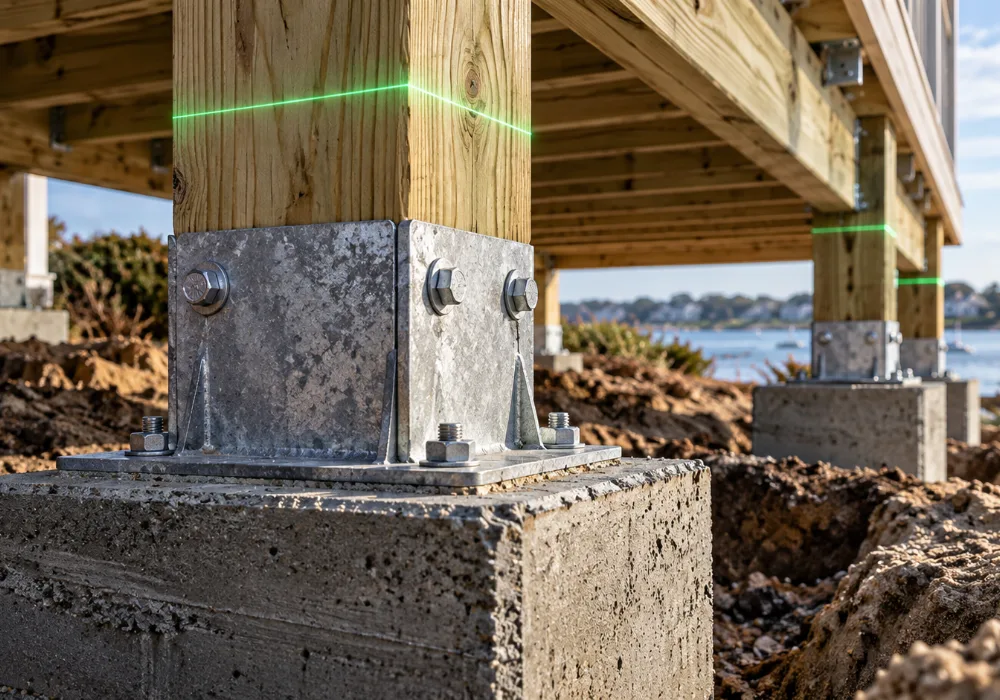
A deck that was level on the day it was built can slowly stop being level. The change is gradual, and most Orleans homeowners first notice it as a corner that sits a little higher than it used to, or a post base that no longer looks tight against the concrete. That movement almost always starts below grade, where footing choices made during construction decide how the deck behaves through every winter that follows. Lions Siding & Roofing builds and replaces decks across Cape Cod, and the footing is where we begin every Orleans project.
Warning Signs Your Orleans Deck Footings Are Moving
Before any design work, we look for the visible evidence of footing movement:
- A slope toward one corner that has grown over two to four years.
- A visible gap between a post base and the concrete beneath it.
- Cracked ledger bolts or a displaced joist hanger seat where the deck meets the house.
- Boards that were flush at installation and now sit at different heights.
A slope greater than 1/4 inch per foot across the deck plane means the connections at the affected posts should be evaluated before the deck carries a full crowd.
Decision 1: How Deep the Footing Goes
Massachusetts requires deck footings to reach at least 42 inches below grade to clear the frost line. That is the floor, and it is where a compliant deck starts. On lots where soil moisture stays high, we go to 48 inches, because frost needs moisture to generate lifting force and the extra six inches puts the bearing surface deeper into a more stable part of the soil column.
Decision 2: How Wide the Footing Is
A 10-inch footing satisfies the depth requirement but offers limited bearing area. Moving to a 12-inch diameter increases bearing area by 44 percent, which lowers the stress at the footing and soil interface, the point where uneven settling begins during the spring thaw.
Decision 3: Where the Water Goes
We surround each footing with a 6-inch gravel collar that runs from the top of the footing to within 12 inches of grade. The collar gives surface water and rising moisture a path away from the footing face instead of letting it collect at the depth where frost does its work.
Decision 4: How the Post Meets the Footing
Post bases are specified with standoff designs that keep the base plate above grade and let water drain freely from beneath it. Water trapped at the post-to-footing joint speeds up both frost movement and corrosion of the connector. Our Truro deck footings guide covers how this detail pairs with PVC decking above it.
Why Outer Corners Rise First
Frost pushes footings upward each winter and they settle back only partially each spring. Posts at the outer corners carry less tributary load, so they have less dead weight resisting that uplift. The house-side ledger stays fixed while the outer corner climbs, and the difference in elevation adds bending stress at the ledger connection that the original design never accounted for. For more on that connection, read our Cotuit ledger and flashing guide.
Releveling an Existing Deck or Replacing the Footings
Footings that moved but remain intact, with no cracks and no separation from the post base, can sometimes stay if the framing is releveled and reconnected at the new elevation. Footings that moved because they were too shallow will keep moving, so we recommend replacement whenever depth or diameter is insufficient, even if the footing looks fine. We assess each footing individually. If the deck meets a trimmed entry or door, our Orleans exterior trim guide explains how the finished edges are handled. For wind exposure on a Cape deck, see our Chatham dual-coast deck guide. To plan your budget across services, read how much siding and roofing cost on Cape Cod.
Frequently Asked Questions (FAQ)
How do I know whether my deck slope comes from the footings?
A slope that develops gradually over two to four years, with a corner rising while the house side stays fixed, points to footing movement. We confirm it by measuring footing elevation at each post and comparing it to the original grade.
Is a 42-inch footing enough in Orleans?
42 inches meets the Massachusetts frost line requirement. On lots with high soil moisture we extend to 48 inches as standard practice, after probing soil moisture at the proposed footing locations.
Why does Lions use 12-inch footings?
The wider footing increases bearing area by 44 percent over a 10-inch footing, which reduces the stress that drives differential settlement.
Can I keep my old footings?
Possibly, if they are intact and can accept new connector hardware. If the root cause was insufficient depth, they will keep moving and should be replaced.
Is the deck unsafe to use if a post base has separated?
Separation removes the designed resistance to lateral and uplift loads at that post, so it should be inspected before the deck is used for gatherings.
Ready to find out what is happening beneath your deck? Request a Free Project Review at (774) 338-6234 or visit roofinglions.com to schedule your Orleans deck consultation.