
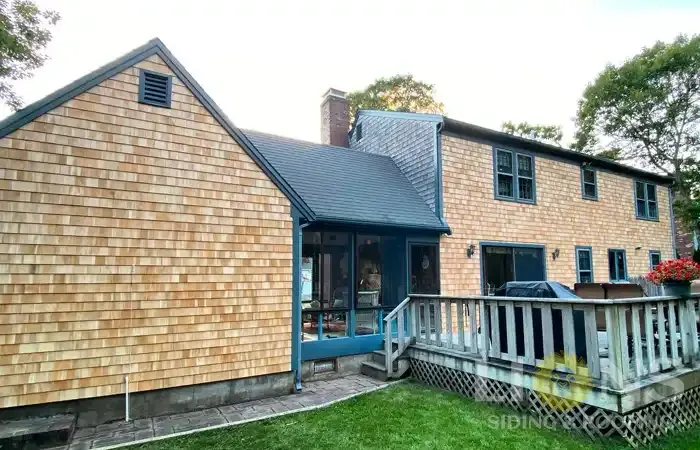
Norwell Siding Replacement: Defeating the Silent Threat of River Humidity and Tree Canopy Moisture (2026)
Table of Contents – Why Norwell siding fails differently than coastal South Shore towns – The North River Microclimate: Humidity, Shade, and Slow-Dry Cycles – Field Report: What a Decade of Norwell Siding Inspections Reveals – Building a Humidity-Resistant Exterior Envelope – Premium Integration: James Hardie HardieZone 5 + Azek PVC Trim – Frequently Asked Questions (FAQ) |
Norwell sits apart from the rest of the South Shore in a way that matters more for siding performance than most homeowners realize. Bordered by the North River and the Indian Head River, and covered by some of the densest residential tree canopy in Plymouth County, Norwell faces almost none of the salt spray and storm surge exposure that drives siding failure in Scituate, Marshfield, or Duxbury. Instead, it faces a quieter, slower-moving threat: trapped humidity.
The North River has carried real historical weight in this region, it was once one of New England’s most active shipbuilding waterways in the 18th and 19th centuries, with dozens of vessels built along its banks. That same low-lying, water-adjacent geography that made it ideal for shipbuilding now creates a microclimate that lingers with fog and humidity longer than higher, more open South Shore neighborhoods. Combine that with mature tree cover that blocks the sun and wind needed to dry exterior surfaces after rain, and you get a siding failure pattern that looks completely different from anything happening twelve miles east on the coast.
Lions Siding & Roofing has worked on siding projects throughout Norwell’s wooded and riverside neighborhoods. This guide explains why “not being on the coast” does not mean your siding is safe from moisture damage, it just means the damage shows up differently, and often later, than homeowners expect.
Why Norwell Siding Fails Differently Than Coastal South Shore Towns
Three factors define Norwell’s distinct exterior moisture profile:
- No direct salt exposure, but no fast drying either: Without coastal wind and direct sun exposure, Norwell siding that gets wet during a storm can stay damp for days rather than hours, particularly on north-facing walls shaded by mature trees.
- River bottomland humidity: Properties near the North River and Indian Head River sit in low-lying terrain where fog and elevated humidity linger longer into the morning than on higher ground elsewhere in town, extending the daily window during which siding surfaces stay wet.
- Organic debris accumulation: Dense tree canopy means a steady accumulation of leaves, pollen, and organic debris in J-channels, behind shutters, and at trim intersections, material that holds moisture against the siding surface and actively feeds mold and mildew growth.
The North River Microclimate: Humidity, Shade, and Slow-Dry Cycles
Norwell’s position along the North River floodplain creates a measurably different humidity pattern from higher-elevation, more open South Shore neighborhoods. Low-lying riverside areas trap cool, moist air overnight, producing morning fog that can persist later into the day than in neighboring towns with more open exposure to sun and wind.
Layer dense residential tree canopy on top of that humidity pattern, and the result is a slow-dry cycle: a typical rain event that would leave open-exposure siding dry by mid-afternoon can leave shaded, canopy-covered siding in Norwell damp well into the evening or even overnight. Repeated over hundreds of rain events across a decade, this slow-dry pattern creates ideal conditions for mold, mildew, and ultimately wood rot, not because the storms are more severe, but because the surfaces never get a chance to fully dry between them.
This is fundamentally a question of exposure engineering, the same principle behind our Dennis Micro-Climate Engineering guide, which addresses how a single home can have dramatically different siding performance needs from one side to the other. In Norwell, that principle extends across the entire property, since most of the town shares a similar shaded, low-airflow profile rather than the sun/shade split seen in a typical Cape Cod home.
Field Report: What a Decade of Norwell Siding Inspections Reveals
Based on Lions Siding & Roofing’s project history across Norwell’s wooded and riverside neighborhoods:
- The Shaded-Side Mold Rate: 65% of wood and vinyl siding installations we inspect on heavily shaded, north-facing walls in Norwell show visible mold or mildew staining by year 8–10, compared to under 20% on open, sun-exposed walls on the same properties.
- The Hidden Rot Pattern: Because moisture-driven siding failure in Norwell develops gradually rather than dramatically, hidden rot behind siding in heavily shaded areas is frequently discovered only during unrelated renovation work, often after 12–15 years of undetected progression.
- The J-Channel Debris Effect: Properties with mature tree canopy directly overhanging the roofline show a measurably higher rate of water staining and rot at J-channel and trim intersections, driven by organic debris holding moisture against the siding surface rather than allowing it to drain freely.
- The Detection Delay: Because Norwell’s siding failures don’t announce themselves the way storm damage does, homeowners typically don’t identify a developing problem until visible staining or soft spots appear, by which point underlying sheathing damage is often already underway.
Building a Humidity-Resistant Exterior Envelope
Addressing Norwell’s moisture profile requires a different set of priorities than a coastal siding project. Four elements matter most:
- Rain screen drainage gap: We install a ventilated rain screen gap behind siding panels on shaded and riverside-facing walls, allowing trapped moisture to drain and air to circulate behind the siding rather than remaining pressed against a damp wall assembly.
- Debris-resistant gutter protection: Given Norwell’s tree canopy density, we frequently recommend gutter guard systems as part of a siding project specifically to reduce the organic debris buildup that holds moisture against trim and J-channel intersections.
- Strategic clearance recommendations: While we don’t perform tree removal, we advise homeowners on canopy clearance that allows meaningfully more sun and airflow to reach siding surfaces, often a simple, low-cost step that measurably improves dry-cycle time.
- Vented soffit upgrades: Many older Norwell homes have soffit ventilation that has become blocked by insulation or debris over time. We assess and restore proper ventilation as part of any comprehensive siding project to support overall wall assembly drying.
Premium Integration: James Hardie HardieZone 5 + Azek PVC Trim
For Norwell siding replacements, we specify James Hardie’s HardieZone 5 formulation, the standard climate formulation engineered for the Northeast’s freeze-thaw cycling and humidity patterns, rather than the coastal HZ10 formulation we use in direct salt-spray environments. The distinction matters: Norwell’s challenge is sustained humidity and shade, not salt chloride exposure, and HardieZone 5 is engineered specifically for that profile.
- Fiber cement construction does not feed mold or mildew growth the way wood siding does, since it contains no organic cellulose material for fungal growth to consume.
- ColorPlus factory finish resists the staining and discoloration that develop on field-painted wood siding in consistently shaded, humid conditions, reducing the repaint cycle that heavily shaded Norwell homes otherwise require every 4–6 years.
- Dimensional stability means Hardie panels do not swell, cup, or warp during Norwell’s extended damp periods the way solid wood siding can.
For trim, corner boards, window surrounds, and fascia, we specify Azek PVC trim for the same underlying reason: PVC does not absorb moisture and does not provide an organic substrate for mold growth, unlike wood trim, which is frequently the first component to show staining and soft spots on shaded Norwell properties.
All Norwell siding projects are permitted through the Norwell Building Department and managed under Lions Siding & Roofing’s Massachusetts licenses (CSL 120645 / HIC 198901).
Frequently Asked Questions (FAQ)
Why is my siding growing mold or mildew if I’m not on the coast?
Mold and mildew growth is driven by sustained moisture and organic material, not salt exposure. In Norwell, dense tree canopy and river-adjacent humidity create exactly the slow-dry conditions that mold needs, even though the town faces none of the salt spray that drives failure in coastal South Shore communities.
Does tree coverage on my property actually damage my siding?
Yes, in two ways: it blocks the sun and airflow that would otherwise dry siding quickly after rain, and it deposits organic debris, leaves, pollen, and seed pods that hold moisture against the surface at trim intersections and J-channels. Both effects compound over the years rather than causing sudden damage.
Should I trim trees away from my house before a siding project?
We generally recommend it where feasible. Increasing clearance and sun exposure even modestly can meaningfully improve how quickly your siding dries after rain, extending the service life of any siding material. We can advise on specific clearance recommendations during your project review, though we do not perform the tree work itself.
Do I need gutter guards as part of a siding replacement?
Not strictly required, but frequently recommended for heavily wooded Norwell properties. Reducing debris accumulation in gutters and J-channels directly reduces one of the primary moisture-retention mechanisms we see driving siding and trim failure in town.
How is Norwell siding maintenance different from coastal South Shore towns?
Coastal towns focus maintenance attention on salt chloride buildup and storm impact. In Norwell, the priority shifts to managing organic debris, monitoring shaded areas for early mold or staining signs, and maintaining airflow around the exterior envelope. The materials that perform best also differ slightly, standard climate-zone formulations rather than coastal-specific products.
Can mold or mildew on siding be a sign of a bigger problem?
It can be. Surface mold on siding itself is typically a maintenance issue, but persistent mold in the same location over multiple seasons can indicate moisture reaching the wall assembly behind the siding. We include a moisture assessment of the underlying sheathing as a standard part of any Norwell siding inspection.
Norwell’s wooded, riverside character is part of what makes the town distinctive, but it demands an exterior envelope engineered for humidity and shade, not the salt-spray playbook used three towns east.