
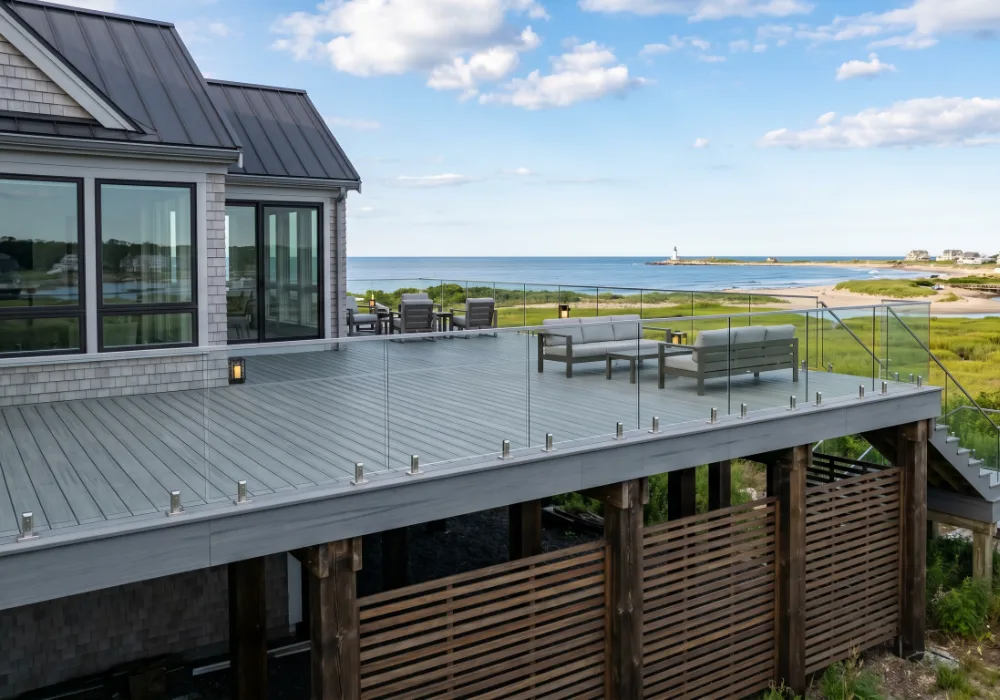
Marshfield holds a distinction among South Shore towns that most homeowners do not discover until they apply for a building permit: large sections of its coastal neighborhoods, Green Harbor, Brant Rock, Ocean Bluff, and Rexhame, sit within FEMA-mapped Special Flood Hazard Areas. For most home improvement projects, this designation is a background detail. For deck construction, it is the determining factor in how the structure must be engineered, what materials qualify, and whether your existing footings can even be reused.
A deck built to standard residential code in an inland town will frequently fail to meet the requirements of a FEMA V-zone or AE-zone designation in coastal Marshfield. The difference is not cosmetic; it involves footing depth below scour elevation, breakaway wall construction in wave-action zones, and connection hardware rated for uplift forces that simply do not apply to a deck built three towns inland.
Lions Siding & Roofing has built and replaced decks throughout Marshfield’s flood-mapped neighborhoods. This guide explains what FEMA flood zone designation actually requires for a deck project, what we find when we inspect decks that were not built to current code, and how to build one that will pass inspection, hold up through a storm season, and support your flood insurance standing rather than undermine it.
Why a Marshfield Deck Answers to a Different Rulebook Than the Rest of the South Shore
Three factors set Marshfield deck construction apart from inland South Shore towns:
- FEMA flood zone designation: Significant portions of Green Harbor, Brant Rock, Ocean Bluff, and Rexhame fall within mapped Special Flood Hazard Areas, with many properties specifically designated V-zone (high-velocity wave action) or AE-zone (base flood elevation without wave action).
- Breakaway construction requirements: In V-zone areas, any structure below the base flood elevation, including deck skirting, lattice, and certain support framing, must be designed to break away under wave load without compromising the structural integrity of the elevated home above.
- Footing depth below scour elevation: Standard frost-line footing depth is not sufficient in flood zone construction. Footings must extend below the calculated scour depth, the depth to which storm surge can erode soil around a foundation, which is typically deeper than standard residential footing requirements.
The Flood Zone Breakdown: Green Harbor, Brant Rock, Ocean Bluff & Rexhame
Each of Marshfield’s coastal neighborhoods carries its own specific flood zone profile based on proximity to open water and historical storm surge data:
- Green Harbor: Marina-adjacent properties here face both tidal flooding from the harbor and direct wave exposure on ocean-facing lots, often placing homes across both V-zone and AE-zone designations depending on exact lot position.
- Brant Rock: One of Marshfield’s most exposed Atlantic-facing neighborhoods, with a long history of direct storm impact. Decks here require the most conservative engineering approach in town.
- Ocean Bluff: Elevated bluff-top properties face a different challenge: erosion risk at the bluff edge that affects footing placement and setback requirements, in addition to standard flood zone rules.
- Rexhame: Dune-backed properties along Rexhame Beach combine flood zone requirements with specific conservation commission oversight related to dune stabilization and beach access.
The underlying engineering discipline here, building structural redundancy into a deck before problems appear, rather than reacting after a failure, is the same philosophy behind our Harwich Port Custom Decks guide, which covers “code-plus” safety engineering for high-use entertaining decks. Marshfield adds a flood-specific layer on top of that same foundational approach.
Field Report: What FEMA Flood Zone Decks Reveal After a Decade of Inspections
Based on Lions Siding & Roofing’s project history across Marshfield’s coastal neighborhoods:
- The Pre-Map Deck Problem: An estimated 60%+ of decks we inspect in Marshfield’s flood-mapped neighborhoods were originally built before the property’s current FEMA flood zone designation took effect, meaning they do not meet present-day breakaway or footing depth requirements even if they were fully code-compliant at the time of construction.
- The Footing Undermining Rate: Following significant storm surge events, decks with footings set above scour depth show measurable undermining or settling at a rate several times higher than decks built to current flood zone footing specifications.
- The Hardware Corrosion Multiplier: Structural hardware on decks subject to periodic saltwater inundation, not just salt spray but actual flood contact, corrodes at a meaningfully faster rate than hardware exposed only to coastal air, making fastener and connector specification a critical decision rather than an afterthought.
- The Insurance Documentation Gap: Homeowners who cannot produce documentation showing their deck meets current flood zone construction standards frequently face additional scrutiny or exclusions during flood insurance claims, even when the deck itself was not the source of damage.
Engineering a Deck for V-Zone and AE-Zone Compliance
Building a flood-zone-compliant deck in Marshfield follows a sequence that differs meaningfully from standard residential deck construction:
- Confirm your property’s exact flood zone designation and base flood elevation before any design work begins. This is pulled from current FEMA flood maps and, where available, your property’s elevation certificate.
- Calculate footing depth below the scour elevation rather than relying on the standard frost-line depth alone. In Marshfield’s coastal zones, this typically requires footings several feet deeper than a comparable inland deck.
- Design breakaway elements for any skirting, lattice, or screening below the base flood elevation in V-zone properties, ensuring these components release under wave load without transferring force to the main structural posts.
- Specify uplift- and lateral-load-rated connectors at every structural connection, sized for the wind and wave forces specific to your flood zone classification rather than standard residential connector hardware.
- Document every structural detail with photos before backfilling or enclosing any component, providing a complete record for insurance purposes and future resale disclosures.
Premium Integration: TimberTech Composite Decking + Coastal-Rated Structural Hardware
For decking material in Marshfield’s flood zone neighborhoods, we specify TimberTech composite decking as the standard recommendation. The reasons are specific to flood exposure rather than general coastal durability:
- TimberTech composite boards do not absorb floodwater the way pressure-treated lumber does, meaning a board that experiences periodic tidal or storm surge contact will not swell, cup, or warp the way wood decking does after saturation.
- The capped composite construction resists the mold and mildew growth that frequently develops in wood decking after repeated wet-dry cycling in flood-prone areas.
- TimberTech’s 50-year structural and fade warranty provides a performance guarantee that is simply not available with pressure-treated lumber in a flood zone application.
For all structural hardware, joist hangers, post bases, and ledger connections, we specify stainless steel or heavy hot-dip galvanized connectors rated for coastal and flood exposure, not standard zinc-coated hardware that corrodes prematurely under repeated saltwater contact.
Lions Siding & Roofing manages the full permitting process for Marshfield deck projects, including coordination with the Marshfield Building Department and, where applicable, the Conservation Commission for properties near protected dune or wetland areas, under CSL 120645 / HIC 198901.
Frequently Asked Questions (FAQ)
Do I need a flood zone elevation certificate before building a deck?
In most cases, yes, if your property falls within a mapped Special Flood Hazard Area. The elevation certificate establishes your property’s base flood elevation, which directly determines footing depth, breakaway requirements, and other design specifications. We help coordinate this documentation as part of the initial project review.
What is a breakaway wall, and does my Marshfield deck need one?
A breakaway wall is a structural element, typically skirting, lattice, or screening below a home’s base flood elevation, designed to detach and fail under wave action rather than transferring that force to the main structure. If your property is in a V-zone designation, any enclosed area below the base flood elevation generally requires this design approach.
Will a code-compliant deck affect my flood insurance premium?
Documentation showing your deck meets current flood zone construction standards can support your overall property’s flood insurance standing, particularly during claims review. We provide complete photo documentation and engineering specifications for every flood zone deck project specifically for this purpose.
Can I use my existing footings if I’m just replacing decking boards?
This depends entirely on whether your existing footings meet current scour depth requirements for your flood zone designation. Many decks built before current flood maps took effect do not. We assess footing depth and condition as a required first step before any decking replacement in Marshfield’s flood-mapped neighborhoods.
How long does permitting take for flood zone construction in Marshfield?
Flood zone deck permits typically take longer than standard deck permits due to the additional documentation required, plan for several weeks beyond a standard timeline, particularly for properties also requiring Conservation Commission review near Rexhame or other protected areas.
What decking material holds up best after a storm surge event?
Composite decking, particularly capped products like TimberTech, performs significantly better than wood after periodic saltwater contact, since it does not absorb water, swell, or develop mold the way pressure-treated lumber does following repeated wet-dry cycling.
Marshfield’s coastal neighborhoods carry a level of flood zone complexity that most South Shore deck builders aren’t equipped to navigate correctly. Building to that standard from the start protects your home, your investment, and your insurance standing for decades.