
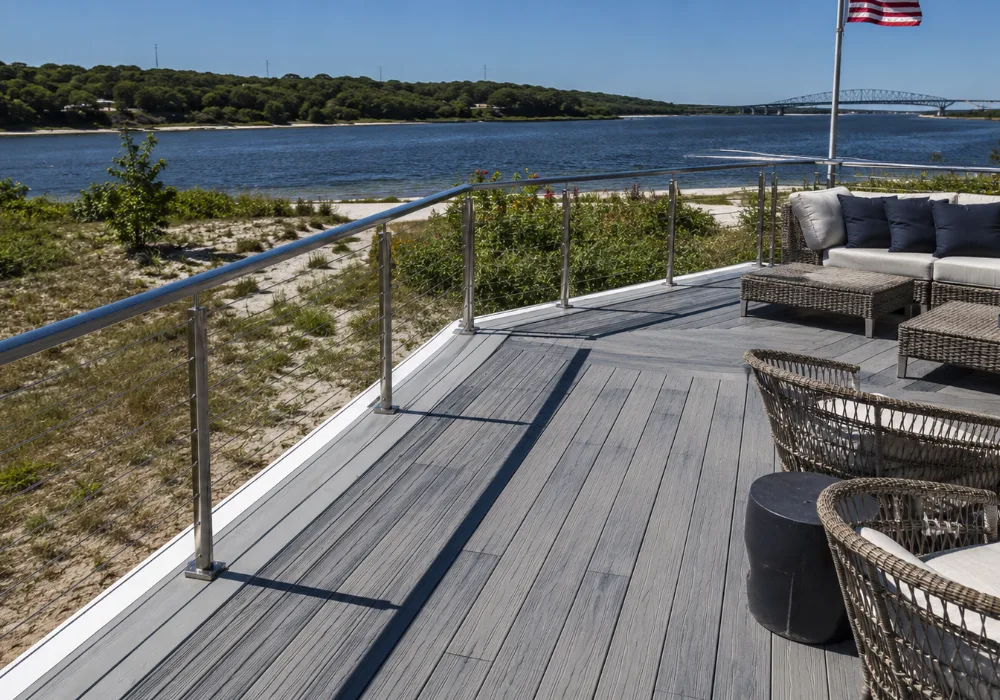
Bourne occupies a position no other Cape Cod town shares: it is cut in half by a man-made canal, bridged by two of the most heavily trafficked spans in New England, and exposed to salt air moving in from two directions at once, Buzzards Bay to the south and Cape Cod Bay to the north. Homeowners here assume their deck problems will look like Sandwich’s or Falmouth’s. They rarely do. Bourne decks fail on their own schedule, driven by two conditions specific to the town: airborne salt drift concentrated by the canal’s wind funnel, and fill soil left behind by decades of canal-adjacent construction and grading.
Why Bourne Decks Fail on a Different Timeline Than the Rest of the Cape
Most Cape Cod deck failures follow a predictable pattern tied to distance from open water. Bourne breaks that pattern because the canal itself acts as a wind channel, pulling salt-laden air off Buzzards Bay and accelerating it through the cut before releasing it into neighborhoods that would otherwise be considered inland. A deck a half mile from the canal in Bourne can see corrosion rates closer to a waterfront property than a comparable inland lot in Sandwich or Mashpee.
The second factor is soil. Much of Bourne’s residential land near the canal corridor was graded, filled, or regraded during the canal’s construction and later widening projects in the twentieth century. This means footing crews frequently encounter soil that does not match what a site’s surface appearance would suggest, compacted fill in one test hole, loose sandy fill three feet away, with no consistent bearing capacity across a single deck’s footing layout.
Cape Cod Canal Salt Drift: A Corrosion Source Most Homeowners Never Suspect
Salt drift from the canal behaves differently than typical coastal salt spray. Rather than arriving as a fine mist off breaking waves, it travels as airborne particulate carried by the wind funnel effect created when air compresses through the canal’s cut. This particulate settles on any exposed metal surface, fasteners, joist hangers, post base connectors, and it does so with a persistence that inland Cape towns rarely experience.
- Standard galvanized fasteners underperform: On canal-corridor Bourne decks, we see galvanized coating breakdown on fasteners and connectors well before the wood decking itself shows wear, a reversal of the failure order typical elsewhere on the Cape.
- Stainless steel hardware is standard on our canal-corridor projects: We specify 305 or 316 stainless fasteners and connectors on any Bourne deck within roughly a mile of the canal, regardless of the deck’s distance from open water on paper.
- Powder-coated aluminum railing systems resist drift corrosion in a way that painted steel railing cannot sustain over a full Bourne deck’s service life.
Fill Soil and Cut-and-Fill Lots: Bourne’s Hidden Footing Problem
A Bourne deck footing project often begins with a soil condition that a visual site inspection cannot fully predict. Canal-era grading left inconsistent fill throughout much of the town’s residential land near the waterway, meaning that footing bearing capacity can shift dramatically across a single deck’s post layout even when the surface soil looks uniform.
This inconsistency is why we probe each proposed footing location individually on Bourne projects rather than applying a single footing specification across the entire deck. A post at one corner may sit on compacted, stable fill while a post twelve feet away encounters loose material that requires either a wider footing base or a deeper bearing point to achieve equivalent load capacity.
The Bridge Traffic Vibration Question
Homeowners near the Bourne and Sagamore Bridge approaches occasionally ask whether traffic vibration contributes to deck movement over time. Vibration from bridge and roadway traffic is a real consideration for structures in close proximity to the approach roads, and while it is rarely the primary driver of deck movement compared to soil and fastener corrosion, we account for proximity to high-traffic corridors when specifying connector hardware and fastening schedules on affected projects.
Field Report: What Bourne Deck Inspections Actually Show
Based on Lions Siding & Roofing’s project history in Bourne’s canal-corridor and waterfront neighborhoods:
- Connector corrosion outpaces decking wear on the majority of canal-corridor Bourne decks we inspect that were built with standard galvanized hardware, a pattern distinct from most other Cape Cod towns where decking surface wear typically precedes hardware failure.
- Footing bearing inconsistency shows up as uneven settlement across roughly one third of Bourne deck replacement projects where original construction did not probe individual footing locations before pouring.
- Railing systems age faster than framing on canal-corridor decks, since railing hardware sits at the exposure height where salt drift concentration is greatest.
Engineering a Bourne Deck: Fasteners, Framing, and Footing Choices
A Bourne deck built for canal-corridor conditions differs from standard Cape Cod deck construction in several specific ways:
- Stainless steel structural hardware throughout, not only at the railing, on any project within the canal’s wind-drift zone.
- Individual footing probing at each post location rather than a single soil assumption applied across the deck.
- Powder-coated aluminum framing as an option where fill soil conditions and salt drift exposure both argue against standard pressure-treated lumber framing.
Material Selection for Canal-Corridor Exposure
For decking surface material on Bourne canal-corridor projects, we look at the same core question that drives our recommendations across the Cape: does the material absorb the moisture and salt exposure the site delivers, or does it resist it. Composite decking with a wood fiber core is a reasonable choice on inland Bourne lots away from the canal, but on canal-adjacent properties we favor fully solid PVC decking systems, the same category of product we specify on our pond-lot Pembroke projects, because there is no organic substrate for salt-driven surface degradation to act on.
Homeowners weighing decking material against a full exterior renovation timeline should review our Bourne exterior overhaul guide, which covers how deck, siding, and roofing timelines can be coordinated on the same project rather than scheduled as separate disruptions.
For homeowners in nearby Pocasset weighing siding replacement costs alongside deck work, our Pocasset siding cost breakdown covers material pricing that applies to much of the same canal-adjacent exposure profile. Sandwich homeowners facing a similar dual-coast wind exposure should also see our Sandwich exterior renovation guide.
Frequently Asked Questions (FAQ)
My deck’s railing hardware looks corroded but the wood itself seems fine. Is this normal?
Yes, and it is one of the clearest signs of canal-corridor salt drift exposure. Standard galvanized fasteners and connectors typically show coating breakdown well before the decking surface shows comparable wear in Bourne’s canal-adjacent neighborhoods. We recommend a hardware inspection independent of decking condition on any Bourne deck more than eight years old.
Do I need special footing engineering if my lot was created from canal-era fill?
We recommend individual footing probing at each proposed post location on any Bourne lot near the canal corridor, since fill soil consistency can vary significantly across a single property regardless of how uniform the surface appears.
Is stainless steel hardware worth the added cost on a Bourne deck?
On any deck within the canal’s wind-drift zone, yes. The cost difference between galvanized and stainless hardware is modest relative to full project cost, while the service life difference in this specific exposure environment is substantial.
Request a Free Project Review at (774) 338-6234 or visit roofinglions.com to schedule your complimentary Bourne deck consultation.