
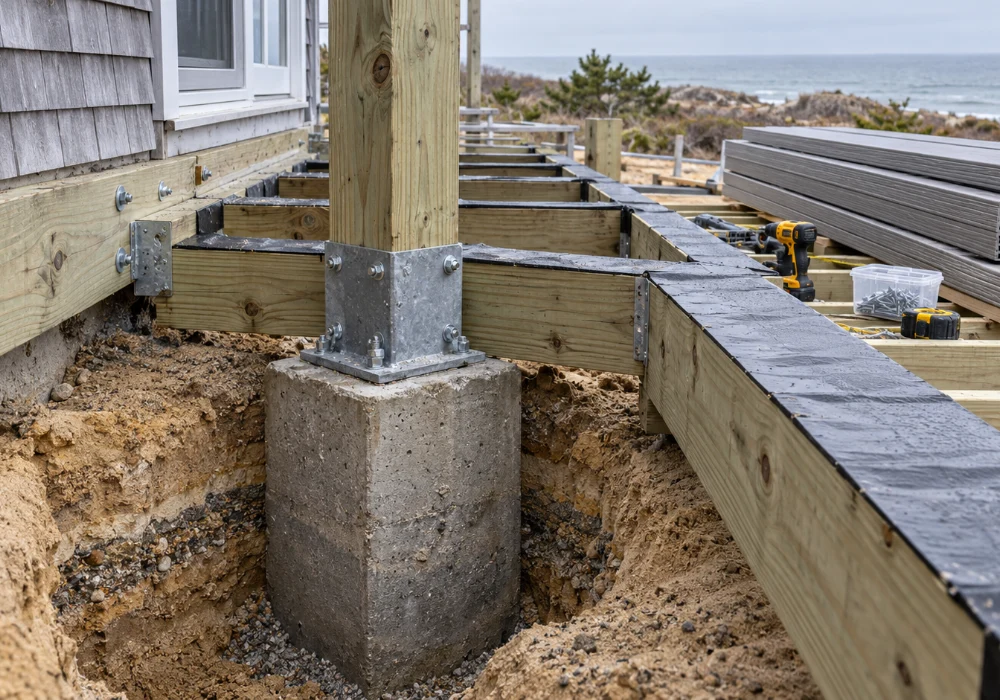
A deck is a stack of decisions, and every decision rests on the one beneath it. Truro homeowners tend to judge a deck by the boards they walk on, yet the boards are the last layer in the stack. This guide works from the ground up, the same order our in-house crew follows on a Truro deck replacement, so you can see where a deck earns its long life and where it quietly loses it.
Layer One: Footings Below the Frost Line
Massachusetts requires deck footings to extend at least 42 inches below grade to clear the frost line. That number is the floor of the conversation, and a footing that stops short of it will rise a little every winter. Each spring the soil only partly settles back, so the deck drifts out of level one post at a time. By the time a homeowner notices a slope, the movement has usually been building for years.
Posts that carry less load, such as the outer corners, tend to lift first because they have less weight holding them down. The house side stays fixed, which means the slope grows toward the yard. When we replace a Truro deck, we check each footing individually for depth and diameter before deciding whether it can stay.
Layer Two: Framing in Salt Air
Coastal air carries moisture and salt every day of the year, and it reaches the underside of the deck where nobody looks. Pressure-treated lumber can lose its protection over time in a high-moisture setting. For elevated decks with exposed framing, we specify powder-coated aluminum framing as an alternative. Aluminum does not rot or warp from sustained moisture, and homeowners who choose it avoid the chemical treatment that lumber carries.
Our Falmouth team approaches the same exposure from another angle in Falmouth MA Deck Replacement and Salt Air, which is worth reading if your framing sits close to open water.
Layer Three: The Ledger at the House
The ledger is the board that ties the deck to your home, and it is where water most often finds a way in. If the footings move while the ledger stays put, the connection takes bending stress it was never designed to carry. Flashing at this joint decides whether water runs away from the house or behind it. We explain that detail step by step in Cotuit MA Deck Replacement: Ledger Flashing.
Layer Four: Choosing the Decking Surface
For high-moisture coastal locations, we recommend Fiberon Paramount PVC decking. Paramount is 100% PVC throughout, so it contains no wood fiber to absorb ambient moisture. Capped composite products combine wood fiber with a polymer shell, and that fiber core can take on humidity even when the cap is intact. Solid PVC leaves mold nothing organic to colonize, which matters most on shaded sections of a deck.
Fiberon also backs Paramount with a lifetime limited warranty covering stain, fade, and structural integrity. If you want to compare another premium option, our guide to custom TimberTech decks in Sandwich covers a different material for coastal living.
Layer Five: Life After Installation
A deck built from the footings up asks very little of its owner. An annual walk-around is enough: check that each post base still sits tight against its footing, look for new gaps along the ledger, and confirm the surface still drains. A gap under a post base is the earliest visible sign that frost has moved a footing, and catching it early keeps a small repair from becoming a rebuild. Coastal exposure also tests siding and trim near the deck, so a deck project is a good moment to review the wall behind it. Our 5 warning signs of hidden exterior rot list shows what to look for.
Frequently Asked Questions (FAQ)
How deep should deck footings be in Truro?
Massachusetts sets a minimum of 42 inches below grade. We assess each site and recommend more depth where moisture conditions call for it.
My deck has started to tilt. Is that frost heave?
A slope that grows over several years, usually rising at an outer corner while the house side stays fixed, points to frost heave. We measure footing elevation at each post to confirm.
Can I keep my existing footings?
Sometimes. Footings that remain intact, sit at adequate depth, and can accept new connector hardware may be retained. A footing that heaved because it was too shallow will keep heaving, so we recommend replacing those.
Why choose PVC over capped composite?
Solid PVC has no wood fiber, so it has no organic material to absorb humidity or feed mold. That makes it a strong fit for damp, shaded coastal decks.
Is aluminum framing strong enough?
Yes, when properly engineered. Aluminum systems are designed to meet residential span and load requirements, and we include the product documentation with the permit application.
A Truro deck that stays level is the result of getting the bottom layers right. Request a Free Project Review at (774) 338-6234 or visit roofinglions.com to schedule your complimentary Truro deck consultation.