
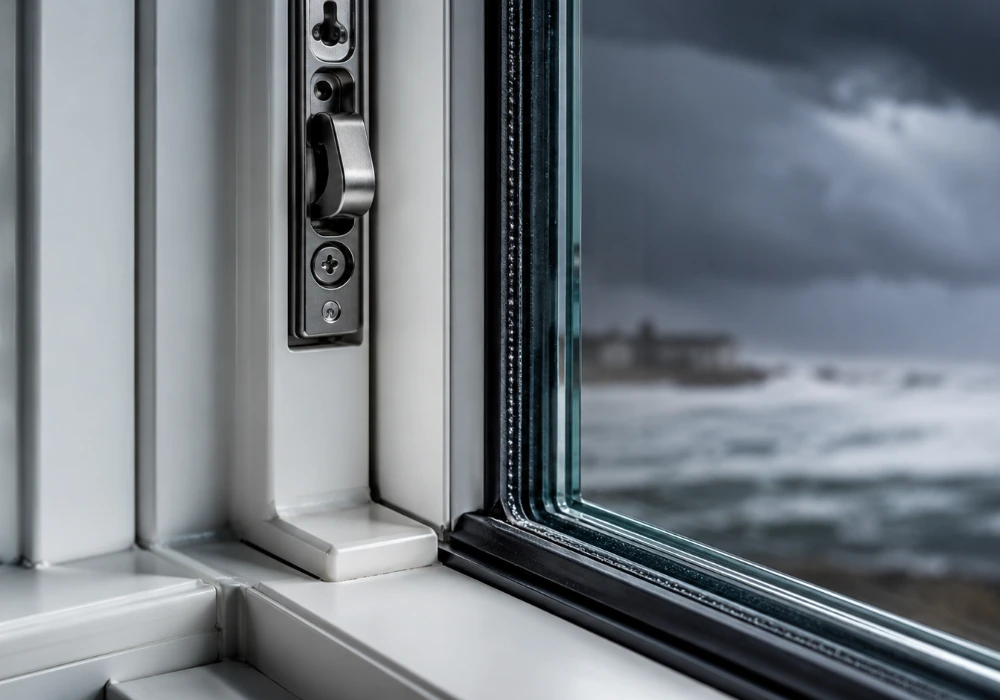
Dennis Port homeowners tend to notice window and door problems in a very specific way: not through a single dramatic failure, but through a slow accumulation of small annoyances, a door that used to close easily, a window lock that has started to stick, a draft near a casing that was not there a few winters ago. Individually these seem minor. Together, they are usually a sign that wind-driven rain and salt air have been working on hardware and seals for longer than most homeowners realize.
The Five-Point Dennis Port Window & Door Checklist
- 1. Lock and latch resistance. If a window lock or door latch requires noticeably more effort to operate than it did a year or two ago, corrosion or swelling is likely underway at the hardware level.
- 2. Visible drafts at the casing. Air movement felt around a closed window or door frame, particularly on the side of the house that faces prevailing coastal wind, indicates the seal has degraded.
- 3. Condensation between panes. Fogging inside a double-pane window means the seal has failed and the insulating gas has escaped, a problem that worsens rather than resolves on its own.
- 4. Visible corrosion on exterior hardware. Hinges, handles, and locks showing rust or white oxidation are past the point where cleaning alone restores function.
- 5. Difficulty closing fully. A door or window that no longer sits flush in its frame often indicates frame movement or swelling from repeated moisture exposure.
If two or more of these apply to a window or door on your home, it is worth having the unit evaluated before the next storm season rather than after storm damage forces the issue.
Why Hardware Fails Before Glass Does
Glass itself is largely inert to salt air exposure, which is why homeowners are often surprised when a window fails structurally before the glass shows any problem. The vulnerable components are the metal hardware, the seals, and the frame material, all of which are directly exposed to wind-driven salt spray during nor’easters and to the sustained coastal humidity that defines Dennis Port’s exterior environment between storms. This is the same mechanism that drives premature hardware failure across coastal Cape Cod, and it means the age of the glass unit is a poor indicator of whether a window is due for replacement.
When Window Problems Point to a Larger Exterior Issue
Window and door hardware failure rarely happens in isolation on a coastal Dennis Port home. If the siding around a window opening is also showing wear, our Dennis siding replacement guide covers how we address the same wind and moisture exposure at the wall level. And because window and door performance can vary significantly depending on which side of a Dennis Port home faces prevailing wind, our Dennis micro-climate exterior guide explains why we specify differently for north- and south-facing exposures on the same house.
Frequently Asked Questions (FAQ)
Can I replace hardware only, or do I need to replace the whole window or door?
It depends on the extent of the damage. If corrosion is limited to surface hardware and the frame and seal are still intact, hardware replacement alone may be sufficient. If the frame has swollen or the seal has failed, full unit replacement is typically the more durable solution.
How often should Dennis Port homeowners inspect windows and doors for storm readiness?
We recommend a check before and after the primary nor’easter season each year, since wind-driven rain exposure during that stretch is when hardware and seal degradation accelerates most.
Does the side of the house matter for how quickly windows wear out?
Yes. Elevations facing prevailing coastal wind typically show hardware and seal wear faster than sheltered elevations on the same home, which is why a full-house inspection rather than a single-window assessment gives the most accurate picture.
Request a Free Project Review at (774) 338-6234 or visit roofinglions.com to schedule your Dennis Port window and door consultation.