
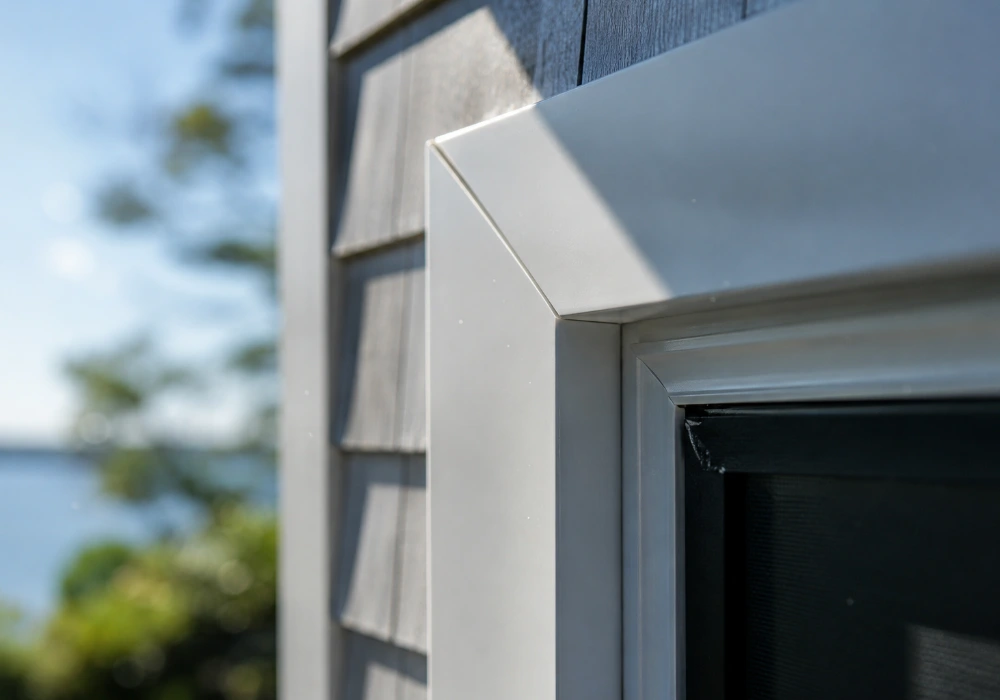
Why Trim Fails Before Siding on Waquoit Bay and Eel River Corridor Homes
East Falmouth’s canal-front and bay-front neighborhoods around Waquoit Bay and the Eel River sit in a pocket of sustained ambient humidity that is measurably higher than Falmouth’s more inland sections. Homeowners in these neighborhoods frequently notice something specific: the trim around windows, at corner boards, and along the roofline starts to show soft spots, paint failure, and visible rot well before the siding field itself shows any comparable wear.
This is not a coincidence of construction quality. Trim components are geometrically more exposed to sustained moisture than flat siding panels, and on a canal-front or bay-front East Falmouth lot, that exposure is compounded by ambient humidity that stays elevated for more of the year than it does on drier, more inland parts of town.
The End-Grain Problem: Where Wood Trim Actually Takes On Water
Wood trim absorbs moisture primarily through end grain and through any point where a factory-sealed surface has been cut or fastened through during installation. Corner boards, window casings, and fascia boards all involve cut ends and fastener penetrations, and each of those points is a potential entry route for moisture once the surrounding paint or sealant begins to break down.
On a property with elevated ambient humidity, the wood at these entry points stays wet longer between drying cycles than it would on a drier inland lot, which is precisely the condition that supports fungal decay. Once rot begins at an end-grain or fastener point, it tends to spread along the length of the board from the inside out, meaning the trim can look sound from the street while the underlying wood is already compromised.
Corner Boards, Frieze Boards, and the Joint Failure Pattern We See Most Often
Across East Falmouth trim replacement projects, the failure pattern tends to concentrate in the same locations:
- Corner boards at the building’s exterior corners, where two cut ends meet and where caulk joints are under the most movement stress.
- Frieze boards and fascia at the roofline, where the trim is exposed to both roof runoff and prolonged shade in some roof configurations, slowing the drying cycle further.
- Window and door casings, where fastener penetrations and butt joints against the siding create multiple potential entry points in a small area.
Homeowners often describe this as a patchwork problem, where one section of trim needs replacing every year or two while the rest of the exterior looks fine, which is exactly the kind of piecemeal deterioration that a unified envelope approach is designed to prevent. We cover this same pattern from the siding side of the equation in our Centerville siding and trim guide.
Cellular PVC Trim as a Direct Fix for a Moisture-Driven Rot Problem
Because the East Falmouth trim problem is fundamentally a moisture absorption problem, the most direct fix is removing the material’s ability to absorb moisture in the first place. Cellular PVC trim contains no wood fiber and does not absorb ambient humidity through end grain or fastener penetrations the way that solid wood or engineered wood trim products do. It also does not require the ongoing repainting that wood trim needs to keep its protective coating intact against a sustained-humidity environment.
The tradeoff homeowners should understand is that cellular PVC trim performs differently under temperature swings than wood, and it should be installed with fastening and joint details appropriate to the material rather than treated as a direct wood substitute installed the same way wood would be.
Coordinating Trim With Siding and Windows So the Whole Envelope Moves as One System
Trim does not function in isolation. It meets the siding field at every corner and every window and door opening, and if the trim, siding, and window flashing are not integrated as a single water-management system, moisture can still find a path into the wall assembly even after new trim is installed. On East Falmouth’s canal and bay-front lots, we generally recommend evaluating trim, siding condition, and window flashing together rather than replacing trim in isolation, particularly on homes where more than one section of trim has already needed repair.
For homeowners weighing a full exterior approach rather than a trim-only fix, our Falmouth siding and roofing contractor guide covers how we coordinate these trades in-house rather than through subcontractors.
Frequently Asked Questions (FAQ)
My trim looks fine from the ground but a contractor mentioned soft spots. How is that possible?
Rot often begins at end-grain and fastener points and spreads along the interior of the board before it becomes visible at the painted surface. A soft-spot test with a probe at corner boards, casings, and fascia is the reliable way to confirm what paint condition alone cannot show.
Why does my East Falmouth neighbor’s inland home not have this problem, even with the same trim material?
Ambient humidity is not uniform across Falmouth. Canal-front and bay-front lots near Waquoit Bay and the Eel River retain higher ambient moisture for more of the year than inland sections of town, which shortens the service life of moisture-absorbing trim materials specifically in those neighborhoods.
Is it worth replacing trim now if my siding still has years of life left?
Yes, when the rot is active, because untreated rot at a corner board or casing can eventually compromise the sheathing and framing behind it, turning a trim repair into a larger structural repair. Replacing trim with a non-absorptive material while the siding is still sound is generally the more cost-effective sequence.
Can cellular PVC trim be painted to match my existing exterior colors?
Yes, cellular PVC trim accepts paint and is available in factory colors as well, giving homeowners flexibility to match an existing color scheme or update it as part of the project.
Request a Free Project Review at (774) 338-6234 or visit roofinglions.com to schedule your complimentary East Falmouth exterior trim consultation.