
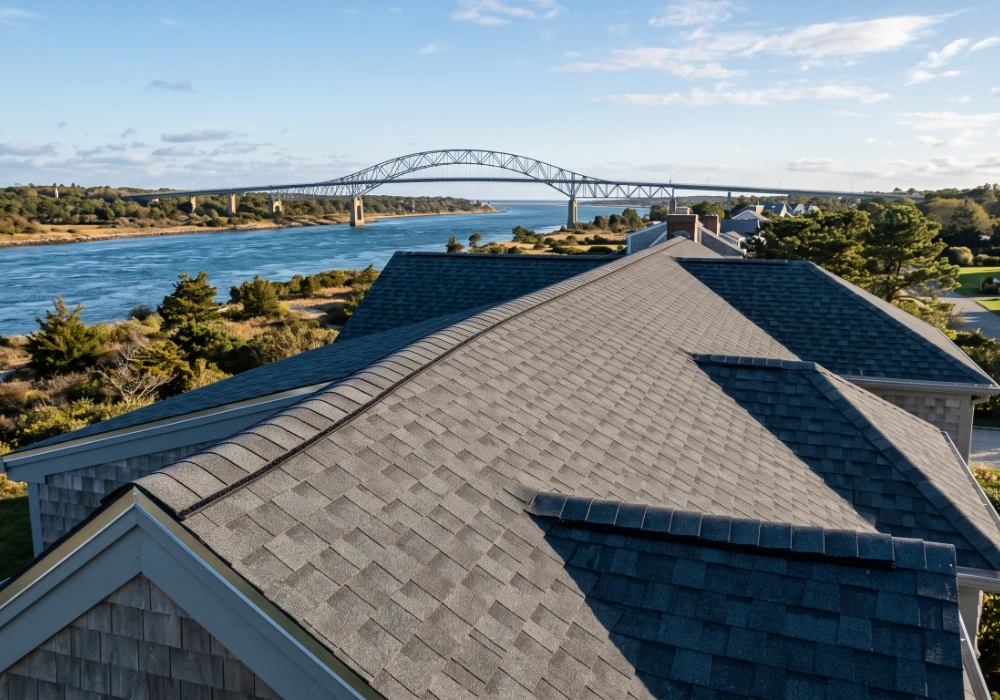
Bourne occupies a position on Cape Cod that no other town shares: it sits at the canal gateway, with the Cape Cod Canal running through it on one side and Buzzards Bay open water on the other. That geography means Bourne homes do not face wind from a single prevailing coastal direction the way most South Shore or outer Cape properties do. They face two distinct wind patterns, and a roof built for only one of them is a roof built for half the exposure it will actually experience.
A Roofing Challenge From Two Directions
Most Cape Cod roofing guidance assumes a single dominant wind exposure, typically driven by the nearest open water. Bourne breaks that assumption. Homes near the canal experience wind that has been funneled and accelerated by the waterway’s geometry, a channeling effect that produces gusts stronger than the general regional forecast would suggest. Homes closer to Buzzards Bay, meanwhile, face the more familiar open-water wind pattern common to the Cape’s bay-side communities. Many Bourne properties sit close enough to both influences that a roof system needs to perform under either condition, not just the one that seems most obvious from the home’s orientation.
How the Cape Cod Canal Changes Local Wind Behavior
Waterways of the canal’s scale can funnel prevailing wind and increase local wind speed beyond what open, unchannelled terrain would produce nearby. For roofing purposes, this means a canal-adjacent Bourne home can experience wind uplift forces at the roof edge and ridge that exceed what a standard regional wind-zone rating would anticipate for a property at that latitude. Roof edges, ridge caps, and hip transitions are the areas most vulnerable to this uplift, since these are the points where wind pressure changes most abruptly as it moves across the roof plane.
Buzzards Bay Exposure and Its Own Wind Pattern
On the Buzzards Bay side of town, the exposure pattern more closely resembles what we address on other bay-facing Cape properties, with sustained onshore wind and the salt-air corrosion concerns that come with any open-water proximity. The distinction in Bourne is that a single property, depending on its exact position relative to both the canal and the bay, may need a roof system engineered to resist both channelled canal wind and open bay wind rather than one or the other. We assess each Bourne roof individually against both exposure sources during a site consultation rather than defaulting to a single standard coastal specification.
Fastening and Underlayment Choices for Crosswind Conditions
- Enhanced fastening patterns: Roofs facing dual wind exposure benefit from fastening patterns that exceed the manufacturer’s standard nailing schedule, particularly at the perimeter and ridge, where uplift forces concentrate first.
- High-wind rated underlayment: A synthetic underlayment rated for high-wind installation provides a secondary water barrier that remains effective even if the primary roofing material experiences localized damage during a severe wind event.
- Sealed ridge and hip details: Ridge and hip caps are the roof’s most wind-exposed components, and proper adhesive sealing at these transitions is what prevents the wind-driven uplift that leads to cap loss during a nor’easter or canal-channelled gust event.
Why Roof Geometry Matters as Much as Materials in Bourne
Material selection alone does not solve a dual-exposure wind problem. Roof geometry, including the number of hips versus gables, the pitch, and the size of overhangs, all influence how much wind uplift force a given roof plane actually experiences. A hip roof generally performs better under high-wind conditions than a gable roof of the same pitch, because a hip roof presents less flat surface area for wind to catch directly. For Bourne homeowners planning a full exterior renovation rather than an isolated roof replacement, coordinating roofing decisions with siding and trim choices from the start avoids the kind of piecemeal approach that leaves gaps in a home’s overall wind resistance.
Our Bourne Exterior Overhaul guide covers how we sequence a full exterior project across siding, decks, and roofing for Bourne properties, which is worth reviewing alongside this guide if your roof replacement is part of a larger renovation. For comparison against another Cape town facing severe wind-driven roofing challenges, our Chatham Roof Replacement guide details the high-wind armor approach we apply on the outer Cape’s most exposed roofs.
Frequently Asked Questions (FAQ)
How do I know if my Bourne home is close enough to the canal to need the enhanced wind specification?
Proximity to the canal’s channeling effect depends on your property’s exact position relative to the waterway and the surrounding terrain, not just straight-line distance. We assess this as part of every Bourne roofing consultation by reviewing the property’s orientation to both the canal and Buzzards Bay before recommending a fastening and underlayment specification.
Is a hip roof always better than a gable roof for Bourne’s wind exposure?
Generally, yes, a hip roof of comparable pitch presents less vulnerable surface area to wind uplift than a gable roof. However, roof geometry is only one factor among several, including fastening pattern, underlayment, and ridge detailing, all of which we evaluate together rather than treating roof shape as the only variable that matters.
My roof is only fifteen years old. Could canal wind exposure still be a concern?
Age alone does not indicate whether a roof was originally specified for dual-direction wind exposure. If the roof was installed to a standard regional wind rating without accounting for the canal’s channelling effect specifically, it may be carrying more risk than its age would suggest. We evaluate original installation specifications during any Bourne roof inspection to determine whether the existing system matches the property’s actual exposure.
Does Bourne’s dual wind exposure affect siding and windows too, not just the roof?
Yes. Wind-driven exposure affects every component of a home’s exterior envelope, not just the roof plane. Homeowners addressing a Bourne roof replacement should consider whether siding, trim, and window and door seals are rated for the same dual-exposure conditions, which is part of why we recommend a full exterior assessment rather than evaluating the roof in isolation.
All Bourne roofing projects are permitted through the appropriate local building department and managed under Lions Siding & Roofing’s Massachusetts licenses (CSL 120645 / HIC 198901).
Bourne’s canal-gateway position means a roof built for only one wind direction is a roof built for half the job. Request a Free Project Review at (774) 338-6234 or visit roofinglions.com to schedule your complimentary Bourne roof consultation.