
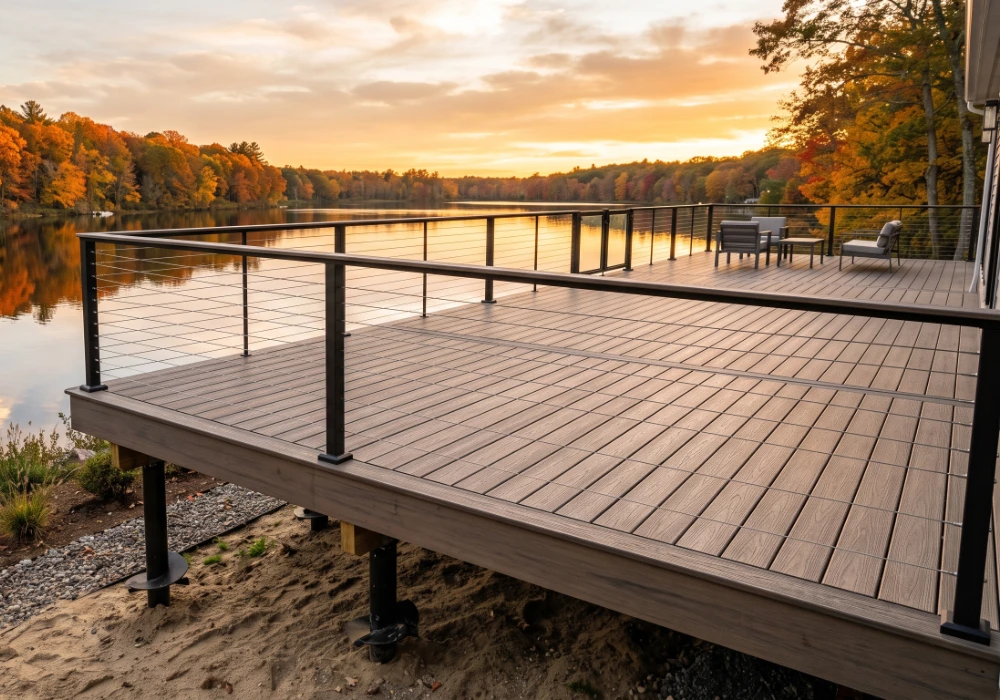
Pembroke’s deck failures do not arrive dramatically. There is no storm event, no granite seawall spray, no Conservation Commission letter. What happens instead is quieter and more insidious: a deck that was level at installation develops a barely perceptible tilt by year three, a more noticeable slope by year seven, and by year twelve has post bases that have visibly separated from the concrete below them or footings that have migrated upward until the deck’s structural connections are no longer doing what they were designed to do. The culprit is Pembroke’s subsoil — the sandy glacial outwash that underlies most of the town’s residential neighborhoods — and its interaction with the Massachusetts frost cycle in a community whose lots sit adjacent to, or in drainage proximity to, the freshwater ponds that define Pembroke’s character as a town.
Frost heave in sandy outwash soil is a phenomenon that surprises homeowners who equate sandy soil with good drainage and assume good drainage means no frost movement. The reality is more nuanced: sandy outwash drains surface water efficiently, but its open particle structure also allows moisture to migrate upward through capillary action from the water table, particularly on pond-adjacent lots where the water table sits closer to the surface than in fully inland neighborhoods. This capillary moisture is exactly what frost needs to generate the expansion force that lifts footings — and on pond-lot properties in Pembroke, it is available in quantity across much of the frost season.
Lions Siding & Roofing has built and replaced decks throughout Pembroke’s pond-side neighborhoods, the Silver Lake corridor, and the residential streets of the North Pembroke and Bryantville areas. This guide explains why Pembroke’s inland freshwater environment creates a deck engineering challenge as specific in its own way as the coastal conditions that define roofing and siding problems on the South Shore’s oceanfront communities.
Why Pembroke Deck Footings Fail Differently Than Coastal South Shore Towns
The contrast between Pembroke’s deck footing challenge and the coastal communities to its east is instructive. In Cohasset, the footing problem is bedrock too close to the surface — the challenge is getting down far enough to anchor into something solid. In Pembroke, the problem is the opposite: subsoil that is consistent and penetrable to any depth but that contains enough frost-accessible moisture to generate significant heave forces on footings that do not clear the frost line with adequate bearing area below it.
Where Cohasset requires ledge-pin anchoring and engineered grade beams to work around bedrock that prevents standard footing installation, Pembroke requires precise frost-depth compliance and drainage engineering to keep footings stationary in soil that offers no bedrock resistance at all. Our Cohasset Deck Replacement guide covers the ledge-anchoring challenge in detail — Pembroke’s pond-lot frost heave is the structural mirror image, where the absence of rock rather than its presence is the engineering problem that shapes every footing decision.
- Sandy outwash particle structure: Pembroke’s glacial outwash soils are composed of well-sorted sand and gravel deposited by meltwater during the last glacial retreat. This particle structure provides excellent surface drainage but also excellent capillary pathways for sub-surface moisture migration — the same characteristic that makes the soil drain well also allows frost-accessible water to travel upward from the water table toward the frost zone during winter.
- Pond proximity and water table elevation: On lots within 300 feet of Pembroke’s freshwater ponds — including Oldham Pond, Furnace Pond, and the Silver Lake watershed properties — the seasonal water table sits close enough to the surface that frost-zone soil moisture levels remain high through the winter, providing the fuel for heave forces that fully drained inland soils would not generate.
- The frost line compliance gap: Massachusetts requires deck footings to extend to a minimum depth of 42 inches below grade to clear the frost line. On Pembroke’s pond-lot properties, 42 inches of depth clears the frost line but does not fully clear the capillary moisture zone above the water table, meaning that footings installed to code minimum in high-water-table locations can still experience modest heave in severe frost winters. We extend footing depth to 48 inches on pond-lot projects as a standard practice.
Glacial Outwash Subsoil: Fast Drainage That Still Moves Under Frost
The misconception that sandy soil cannot produce frost heave is widespread among homeowners and even among some contractors who work primarily in coastal environments where bedrock or dense clay subsoil is the standard condition. The mechanism of frost heave does not require clay — it requires only frost-zone soil moisture and a temperature gradient that drives that moisture to the freezing front. Sandy glacial outwash provides efficient pathways for that moisture movement, and on pond-adjacent Pembroke lots it provides ample moisture supply through the water table proximity that defines these properties.
Frost heave in sandy outwash tends to be more uniform than in clay soils, which can heave differentially across short distances. Uniform heave is in some ways more manageable from an engineering standpoint — if all footings move equally, a deck can remain level even while riding up and down seasonally. The problem in practice is that footing diameter, depth, bearing capacity, and load distribution are never perfectly uniform across a multi-post deck, meaning that some posts heave slightly more than others and the cumulative result over years of seasonal cycling is a deck that has ratcheted out of level one post at a time.
Pond-Lot Drainage and the Moisture Pressure Most Homeowners Miss
Pembroke’s freshwater ponds are the town’s defining landscape feature and the primary driver of lot value in the town’s most sought-after neighborhoods. They are also a persistent source of elevated soil moisture in the yards that surround them, through a mechanism that operates independently of surface drainage: the cone of saturation that extends outward from each pond’s perimeter keeps subsoil moisture levels elevated on adjacent lots throughout the year, including through the winter frost season when that moisture is directly available to generate frost heave forces on deck footings.
The practical implication for deck construction is that standard footing design assumptions — developed for typical inland Massachusetts soil moisture conditions — underestimate the heave potential on Pembroke pond-lot properties. A footing design that performs adequately on a Pembroke inland lot 600 feet from the nearest pond will produce measurable seasonal movement on a pond-front lot where the water table’s seasonal high sits within 18 to 24 inches of the surface. Accounting for this requires adjusting footing depth, diameter, and bearing area specifically for each pond-lot project rather than applying a standard footing specification across all Pembroke locations.
The Seasonal Level Problem: What Frost Heave Does to a Deck Over Ten Years
Frost heave’s effect on a deck is cumulative and directional. Each winter, the frost cycle pushes footings upward by a small amount. Each spring, footings partially settle back as the frost releases. The key word is “partially”: on sandy outwash soils, the settling phase rarely returns a heaved footing to its exact pre-winter position, because the compacted soil beneath the footing face has been disturbed by the upward movement and does not provide the same resistance to downward settlement as it did before heaving. The net result over ten years of seasonal cycling is a footing that has migrated upward by a fraction of an inch per year, producing a cumulative elevation change that is structurally significant even if each individual year’s movement was too small to notice.
The structural consequence of this cumulative migration is not uniform across the deck. Post bases that bear less load — typically at the outer corners of the deck — tend to heave slightly more than posts bearing full tributary load from beam spans, because the lighter-loaded footing has less dead weight resisting the frost uplift force. This differential heave is what produces the visible tilt that Pembroke homeowners most commonly report: a deck that has risen at the outer corner while the house-side ledger connection remains fixed, introducing a slope that increases year over year until the deck’s structural geometry has changed beyond the tolerance of its original fastener and connector design.
Field Report: What a Decade of Pembroke Deck Inspections Reveals
Based on Lions Siding & Roofing’s project history across Pembroke’s pond-adjacent and inland neighborhoods:
- The Tilt Onset Timeline: On pond-lot properties where footing depth was at or near the 42-inch code minimum, measurable deck slope — defined as greater than 1/4 inch per foot across the deck plane — appears at an average of 6 to 9 years post-installation. On properties where footing depth was extended to 48 inches and post bases were specified with positive drainage away from the footing, measurable slope at 10-year inspection is found in fewer than 15% of projects.
- The Post Base Separation Rate: In 60% of Pembroke deck replacement projects on pond-adjacent lots, we find visible separation between one or more post bases and the concrete footing surface below, indicating that frost uplift has exceeded the post base connector’s hold-down capacity. This separation is the primary structural safety concern on frost-heaved decks, as it removes the designed resistance to lateral and uplift loads at the affected post.
- The Ledger Connection Stress Pattern: When outer posts heave while the house-side ledger remains fixed, the differential elevation introduces bending stress at the ledger-to-rim-joist connection that was not part of the original structural design. We find cracked ledger bolts or displaced joist hanger seats at this connection in 35% of Pembroke deck replacements where outer-post heave has been active for five or more years.
- The Composite vs. PT Longevity Gap: Pressure-treated wood decking on Pembroke pond-lot properties shows accelerated checking and surface degradation driven by the high ambient moisture environment adjacent to the ponds, averaging 9 to 12 years before replacement. PVC decking at the same locations shows no moisture-driven degradation at 15-year inspection in every documented Pembroke project, as PVC does not absorb the ambient humidity that drives checking and mold on wood decking in high-moisture environments.
Engineering Footings for Sandy Subsoil: Depth, Diameter, and Drainage
A Pembroke deck footing system for pond-lot properties addresses frost heave through four engineering choices that differ from standard South Shore practice:
- Extended depth to 48 inches: We extend below the Massachusetts frost line minimum by six inches on all pond-lot projects, placing the footing bearing surface deeper into the soil column where seasonal frost penetration does not reach even in severe winters and where water table fluctuation’s influence on soil moisture is more stable.
- Increased footing diameter: Standard 10-inch footing diameter is adequate for frost-depth compliance but provides limited bearing area on sandy outwash where soil bearing capacity is lower than in clay or dense gravel. We specify 12-inch diameter footings on Pembroke pond-lot projects, increasing bearing area by 44% and reducing the unit stress at the footing-soil interface that drives differential settlement during the spring thaw.
- Gravel drainage collar: Each footing is surrounded by a 6-inch gravel collar from the footing top to within 12 inches of grade, providing a drainage pathway that redirects surface and capillary moisture away from the footing face rather than allowing it to pool at the frost-zone bearing surface where it is most available for heave force generation.
- Positive-drainage post base specification: All post bases are specified with standoff designs that keep the post base plate above grade and allow water to drain freely from beneath the post base, eliminating the pooling condition at the post-to-footing transition that accelerates both frost heave and post base corrosion on Pembroke’s high-moisture pond-lot environment.
Premium Integration: Fiberon Paramount PVC + Powder-Coated Aluminum Framing
For Pembroke deck replacements on pond-adjacent lots, we specify Fiberon Paramount PVC decking as the surface material recommendation. Unlike capped composite products that combine wood fiber with a polymer shell, Paramount is 100% PVC throughout — there is no wood fiber content to absorb the ambient moisture that Pembroke’s pond-lot environment delivers continuously. On high-moisture lots where composite decking’s wood fiber core can absorb enough ambient humidity to support surface mold growth despite the capped construction, a fully solid PVC product eliminates the substrate that mold requires.
- Paramount’s cellular PVC construction maintains consistent dimensions across Pembroke’s full temperature range without the differential expansion that produces gapping in colder months and tight-joint pressure in summer — a meaningful advantage on pond-lot decks that experience the full inland temperature swing rather than the moderated coastal temperature range of oceanfront communities.
- The solid PVC composition means that the frost-heave movement that Pembroke’s footings experience seasonally does not produce the fastener-pull and surface-checking that occurs on wood decking when framing members shift relative to each other. PVC’s flexibility distributes minor structural movement across the panel rather than concentrating it at fastener points.
- Fiberon’s lifetime limited warranty on Paramount covers stain, fade, and structural integrity without the moisture-exclusion clauses that some composite warranties include — directly relevant for Pembroke pond-lot applications where ambient moisture exposure is the defining environmental condition.
For framing on elevated pond-lot decks where the underside of the framing is exposed to continuous high-humidity air rising from the pond surface, we specify powder-coated aluminum framing systems as an alternative to pressure-treated lumber. Aluminum framing does not rot, does not warp under sustained moisture exposure, and does not require the chemical treatment that pressure-treated lumber carries — an advantage on pond-lot properties where chemical leachate from PT framing into the adjacent pond environment is a legitimate environmental concern for homeowners who use the pond for swimming or fishing.
All Pembroke deck projects are permitted through the Pembroke Building Department and managed under Lions Siding & Roofing’s Massachusetts licenses (CSL 120645 / HIC 198901).
Frequently Asked Questions (FAQ)
My deck has developed a slope toward one corner over the past few years. Is this frost heave or something else?
A progressive slope developing over two to four years on a Pembroke pond-lot deck is frost heave until proven otherwise. The diagnostic is the corner: outer corners with lower tributary load heave first and farthest, while the house-side ledger remains fixed, producing exactly the corner-up slope you are describing. We can confirm this during a structural inspection by measuring footing elevation at each post and comparing it to the original grade, which shows cumulative heave migration directly. If the slope is more than 1/4 inch per foot across the deck plane, the structural connections at affected posts should be evaluated before the deck is used for full load gatherings.
Can my existing footings be repaired or do they need full replacement?
Footings that have heaved but remain structurally intact — no cracking, no separation from the post base, and capable of accepting new connector hardware — can sometimes be retained if the deck framing is releveled and re-connected at the adjusted elevation. However, footings that have heaved because they were installed at insufficient depth will continue heaving in subsequent frost seasons regardless of releveling, because the root cause — inadequate depth below the frost-moisture zone — has not been addressed. We assess each footing individually and recommend replacement where depth or diameter is insufficient for the pond-lot conditions, even when the footing appears visually intact.
Does a pond-view lot in Pembroke require any special permits beyond the standard building permit?
In most cases, no — Pembroke pond-lot deck projects require a standard building permit through the Pembroke Building Department without Conservation Commission review, unless the proposed deck footprint falls within the 100-foot buffer zone of the pond’s bank or associated wetland resource area. We conduct a resource area proximity check as part of every Pembroke pond-lot consultation and initiate a Request for Determination of Applicability with the Conservation Commission where the project location is within or near the 100-foot buffer, before the building permit application is filed.
Why is PVC decking better than capped composite on a pond-lot Pembroke property?
Capped composite products combine wood fiber with a polymer shell, and the wood fiber core can absorb ambient moisture vapor even when the surface cap is intact. On Pembroke pond-lot properties where relative humidity at deck level is consistently elevated by moisture evaporating from the adjacent pond, this ambient vapor absorption can support surface mold growth on composite decking despite the capped construction. Fully solid PVC contains no wood fiber and therefore provides no organic substrate for mold to colonize. The performance difference is most pronounced on shaded north- and east-facing deck elevations where the combination of pond moisture and reduced sun exposure creates the most persistent mold-favorable conditions.
Is powder-coated aluminum framing structurally adequate to replace pressure-treated lumber framing?
Yes, when properly engineered. Aluminum framing systems for residential decks are designed to meet the same span and load requirements as pressure-treated lumber framing and are accepted under the Massachusetts Building Code with appropriate product documentation. The structural advantage in Pembroke’s pond-lot environment is that aluminum does not lose structural integrity through moisture exposure the way that pressure-treated lumber can when the chemical treatment is not maintained through the wood’s service life. We specify aluminum framing systems with ICC evaluation reports that confirm code compliance and include the product documentation with the building permit application.
How do I know if my Pembroke pond-lot property has a high enough water table to require the extended footing specification?
The most reliable indicator is seasonal observation: if you notice standing water in your yard within 24 hours after a heavy rain has cleared, or if the soil in garden beds remains wet to the touch within 12 inches of the surface in early spring before significant surface evaporation has occurred, your water table is close enough to the surface to warrant the extended footing depth and drainage collar specification. We also assess water table proximity as part of every Pembroke pond-lot site visit by probing soil moisture at proposed footing locations before any design or pricing is finalized.
Pembroke’s pond-lot deck environment is defined by a challenge that is invisible until it has already been working against a deck’s footings for years. Building to the town’s actual subsoil conditions from the start — extended depth, increased diameter, drainage collars, and materials that perform in continuous moisture — means a deck that stays level and stays safe across the full service life it was designed for. Request a Free Project Review at (774) 338-6234 or visit roofinglions.com to schedule your complimentary Pembroke deck consultation.