
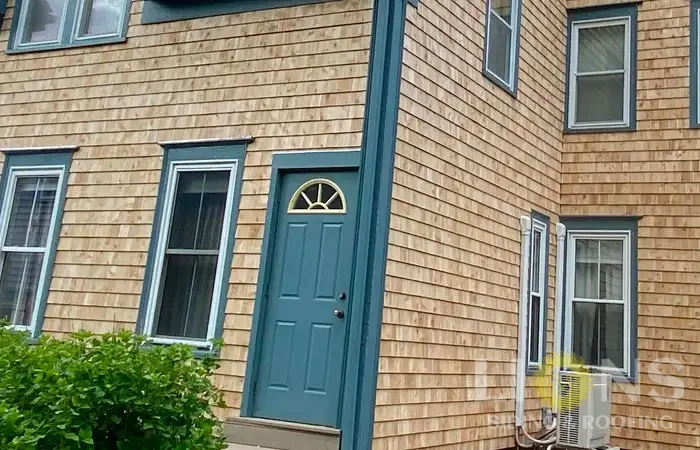
Duxbury sits at a geographic hinge point on the South Shore that its siding tells you immediately. The town faces Duxbury Bay to the west and the open Atlantic to the east, but neither exposure quite mimics what Scituate or Plymouth face. The bay side delivers salt in a patient, diffuse way that accumulates over seasons rather than storms, slowly depositing chloride into siding paint and caulk joints without the dramatic event that would prompt a homeowner to schedule an inspection. The result is a siding failure pattern that is gradual, pervasive, and frequently discovered a decade later than it should have been.
At the same time, Duxbury carries one of the most intact 18th and 19th-century architectural inventories on the South Shore. The Landing Road and King Caesar Road corridors contain some of the finest Federal and Greek Revival homes in Plymouth County, and the town’s strong historic preservation culture means that siding decisions on these properties are not purely technical — they carry architectural and community expectations that a replacement contractor needs to understand before presenting a product recommendation.
Lions Siding & Roofing has worked on siding projects throughout Duxbury’s bay-side, harbor-adjacent, and historic corridor neighborhoods. This guide explains what sets the Duxbury siding challenge apart from neighboring communities, what the cedar shingle tradition means in practical terms for a replacement project today, and how to build an exterior envelope that performs in Duxbury’s environment without compromising the town’s architectural identity.
Why Duxbury Siding Fails on a Different Timeline Than Other South Shore Towns
Two factors combine to create Duxbury’s distinct siding performance profile:
- Bay-side salt creep vs. direct salt spray: Properties facing Duxbury Bay do not receive the direct salt spray loading that oceanfront Scituate or Plymouth homes experience. Instead, they receive persistent low-level salt deposition carried on bay breezes across shallow tidal flats — a slower accumulation that embeds in painted surfaces and caulk joints over years rather than hours, degrading paint adhesion and opening micro-fissures in caulk long before visual evidence appears.
- The double-exposure wedge: Properties in Duxbury’s more northerly bay-side neighborhoods sit in a geometry where prevailing southwest summer winds carry bay humidity across the property while northeast winter winds carry Atlantic moisture from the open coast side, exposing all four walls to elevated moisture loading from different directions across different seasons.
Duxbury Bay Salt Creep: The Slow-Moving Threat Most Homeowners Underestimate
Salt creep from Duxbury Bay operates differently from the storm-surge saltwater contact that damages siding in Marshfield’s flood zone neighborhoods, or the direct spray loading that strips paint from oceanfront Scituate bluff homes. Bay-side salt arrives continuously and in small quantities, carried on the low-speed breezes that cross the bay’s shallow tidal flats through every season.
The cumulative effect of this slow deposition is well-documented in coastal building research: chloride ions penetrate painted wood siding surfaces more effectively than direct spray, because they arrive in small concentrations that the paint film can absorb rather than shed. By the time visible paint failure appears — blistering, chalking, or peeling at lap joints — chloride has already compromised the bond between paint and substrate across a much larger area than is visually apparent. This is why bay-side Duxbury homes frequently require more extensive substrate repair than their visual siding condition suggests at the time of replacement.
The contrast between this slow accumulation failure pattern and the storm-event loading that damages Scituate bluff roofs is stark. Our Scituate Roof Replacement guide covers how direct Atlantic exposure produces dramatic, event-driven damage in a neighboring town — while Duxbury’s bay-side siding challenge is its opposite: damage that accumulates invisibly and announces itself only after the underlying problem is well advanced.
The Landing Road Corridor: Architectural Heritage and Material Expectations
Duxbury’s most architecturally significant residential streets — Landing Road, King Caesar Road, and the streets surrounding the Duxbury Rural and Historical Society properties — contain Federal and Greek Revival homes that set the town’s architectural baseline. Cedar shingle siding, in the traditional New England style, defines the visual identity of this corridor in a way that is broadly understood and respected by contractors, residents, and the historical community alike.
This creates a practical consideration for any siding project in or near these corridors: the choice between true cedar shingles and modern fiber cement products that replicate their profile is not just an aesthetic preference but a question with community and resale dimensions. Properties whose siding reads as consistent with the neighborhood standard retain the architectural legibility that makes Duxbury’s historic streets distinctive. Properties that deviate conspicuously — through inappropriate material choice, incorrect exposure dimensions, or mismatched coursing patterns — stand out in ways that affect both the street and the homeowner’s long-term relationship with the neighborhood.
Field Report: What a Decade of Duxbury Siding Inspections Reveals
Based on Lions Siding & Roofing’s project history across Duxbury’s bay-side and historic corridor neighborhoods:
- The Caulk-Joint Chloride Failure Pattern: On bay-facing walls, we find caulk joint failure at window and door surrounds at an average of 7–10 years on painted wood siding, driven by the slow chloride absorption cycle rather than physical impact. This is the most common first entry point for water infiltration on Duxbury bay-side properties.
- The Paint Adhesion Gap: Field-painted cedar shingle siding in Duxbury’s bay-side neighborhoods averages 5–7 years before repainting is warranted on south and west exposures, compared to 8–10 years for equivalent installations in inland South Shore towns, driven by the combination of UV loading and salt creep degrading the paint-substrate bond faster than a sheltered location would produce.
- The Hidden Substrate Damage Rate: On properties where painted wood siding has reached or exceeded 15 years on bay-facing walls, we find compromised sheathing or framing members requiring repair or replacement in approximately 55% of cases — damage that is invisible from the exterior until siding is removed.
- The Cedar vs. Hardie Decision Split: Among Duxbury homeowners replacing original cedar shingle siding, approximately 60% choose James Hardie HardieShingle fiber cement for its cedar profile with reduced maintenance demands, while 40% retain true cedar for architectural authenticity in the historic corridor neighborhoods. Both are defensible choices in the right context.
Cedar Shingle Tradition vs. Modern Fiber Cement: Choosing the Right Path
The decision between true cedar shingles and fiber cement shingle panels in Duxbury is primarily a question of context and maintenance commitment:
- True cedar shingles: The authentic choice for homes in or adjacent to the Landing Road and King Caesar Road historic corridors, where material consistency with the neighborhood standard is a genuine consideration. True cedar requires a more active maintenance commitment — staining or painting every 5–7 years on bay-facing exposures — but provides a texture, shadow depth, and visual integration with the existing streetscape that fiber cement replicates but does not fully duplicate.
- James Hardie HardieShingle fiber cement: The standard recommendation for bay-side properties where the primary concern is long-term moisture performance and reduced maintenance cycles. HardieShingle’s fiber cement construction does not absorb the slow chloride deposition that drives paint failure on wood siding, and its factory ColorPlus finish resists the degradation cycle that requires repainting every 5–7 years on cedar.
For homeowners in Duxbury’s historic corridors who are drawn to fiber cement for performance reasons but uncertain about its compatibility with the neighborhood’s visual standard, we bring physical sample boards of both products to the initial consultation specifically to allow a side-by-side comparison under the property’s actual light conditions.
Premium Integration: James Hardie HardieShingle + Azek PVC Trim
For Duxbury siding replacements using fiber cement, we specify James Hardie HardieShingle panels in the 7-inch exposure width that matches the coursing standard used historically on Duxbury’s traditional cedar shingle homes. The dimensional match is deliberate: on properties where the new siding will be visible alongside neighboring homes with original cedar, maintaining the same exposure width preserves the visual continuity of the streetscape.
- The fiber cement substrate does not absorb the bay-side chloride deposition that causes paint adhesion failure on wood, meaning the factory ColorPlus finish maintains its bond to the panel face across the full 15-year ColorPlus warranty period without the repainting cycle that cedar requires.
- HardieShingle’s dimensional stability means panels do not expand and contract seasonally the way cedar shingles do, eliminating the joint-opening cycle that creates the caulk failure entry points we document consistently on aging wood siding in Duxbury’s bay-side neighborhoods.
- The non-combustible fiber cement construction provides a meaningful upgrade in fire resistance compared to wood shingles — relevant in Duxbury given the density of mature tree cover adjacent to many historic corridor properties.
For trim — corner boards, window casings, frieze boards, and water tables — we specify Azek PVC trim throughout. On bay-side Duxbury properties, painted wood trim requires repainting on a faster cycle than even the siding panels, driven by direct salt deposition at exposed horizontal surfaces. Azek PVC does not require paint, does not absorb moisture, and will not develop the rot that we frequently find at base-of-wall trim sections on properties with decades of bay-side exposure.
All Duxbury siding projects are permitted through the Duxbury Building Department and managed under Lions Siding & Roofing’s Massachusetts licenses (CSL 120645 / HIC 198901).
Frequently Asked Questions (FAQ)
How do I know if my Duxbury siding has salt damage if the paint still looks intact?
The most reliable indicator is caulk joint condition rather than paint surface condition. On bay-side Duxbury properties, chloride absorption typically degrades caulk joints at window and door surrounds before paint failure becomes visible. We check caulk joint flexibility, adhesion, and substrate condition at these points during every Duxbury siding inspection, since this is where active water entry is most commonly occurring on properties whose paint still looks presentable from the street.
Can I stain cedar shingles instead of painting them to reduce the maintenance cycle?
Yes, and in Duxbury’s bay-side climate, a penetrating semi-transparent stain generally outperforms a full paint system on a longevity-per-dollar basis. Stains penetrate the wood fiber rather than forming a surface film, so they do not fail through blistering and peeling the way paint does when moisture and salt creep compromise the paint-substrate bond. The tradeoff is that stained cedar reads as a natural wood tone rather than the classic white or cream finish common on Landing Road corridor properties, which may not suit every homeowner’s preference.
Does fiber cement look convincing next to original cedar shingle homes in Duxbury’s historic neighborhoods?
At typical viewing distances and with the correct exposure width matched to the surrounding coursing, HardieShingle fiber cement is difficult to distinguish from cedar shingle by eye. The primary difference is tactile rather than visual — the surface texture is slightly more uniform than hand-split cedar. We bring physical samples to the initial consultation specifically so homeowners can make this comparison under their actual property conditions rather than from catalog images.
How much sooner will I need to repaint bay-side cedar siding in Duxbury compared to an inland home?
On south- and west-facing bay-side walls, our project history suggests cedar siding requires repainting at 5–7 years in Duxbury’s bay-facing neighborhoods, compared to 8–10 years for equivalent installations in sheltered inland communities. The accelerated cycle is driven by the combination of UV degradation and salt creep undermining the paint-substrate bond, particularly at caulk joints and lap edges.
Is there a Duxbury historic district review process for siding projects?
Duxbury does not maintain a formal local historic district review process for most residential properties in the way that Hingham or Barnstable Village do. However, the town’s strong preservation culture and the architectural sensitivity of the Landing Road corridor mean that material and color choices on visible properties carry informal community expectations. We discuss these considerations as part of the initial consultation for any property in or adjacent to Duxbury’s historic corridors.
What is the best trim material for a Duxbury home given the salt environment?
Azek PVC trim is our standard recommendation for bay-side Duxbury properties. It requires no paint, does not absorb moisture, and does not rot at base-of-wall sections where standing water and direct bay spray load are highest. For homeowners who prefer a wood-grain appearance, Azek’s Vintage collection provides a textured finish that reads as wood at typical viewing distances while maintaining full PVC performance.Duxbury’s combination of bay-side salt creep, architectural heritage, and a homeowner community that takes its streetscapes seriously means that a siding replacement here is rarely a straightforward material substitution. Getting it right requires understanding what the environment actually demands and what the neighborhood actually expects. Request a Free Project Review at (774) 338-6234 or visit roofinglions.com to schedule your complimentary Duxbury siding consultation.