
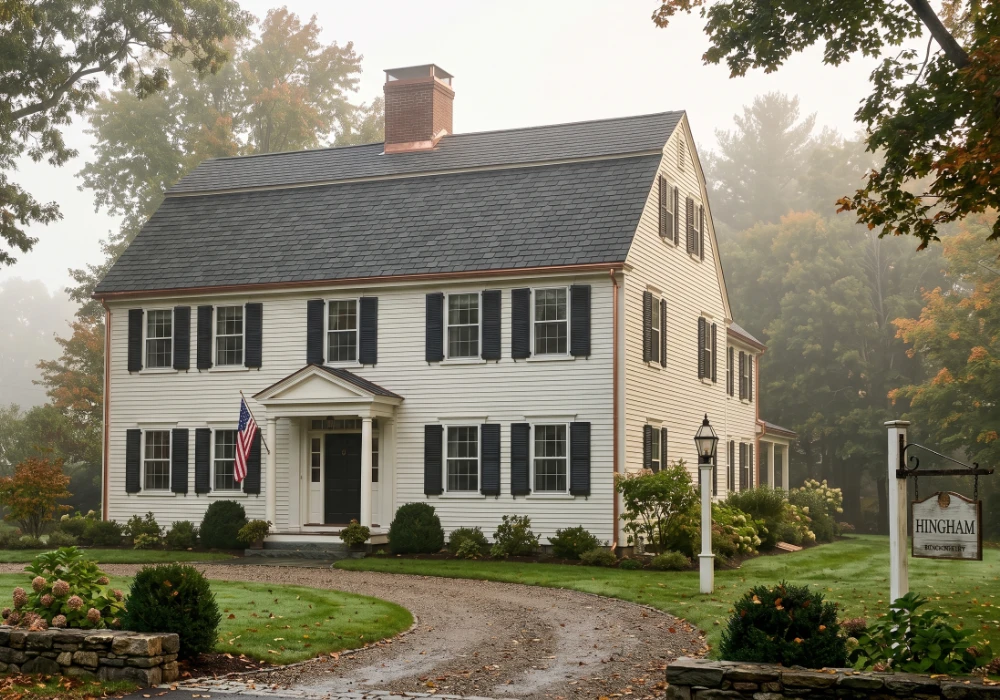
Hingham was settled in 1635, making it one of the oldest continuously developed towns on the South Shore, and one of the few where 18th and 19th-century architecture is not a novelty but the standard. Greek Revival, Federal, and Colonial homes line the streets around Hingham Harbor, Hingham Centre, and the Lincoln Street corridor, many sitting inside locally designated historic districts where exterior changes, including roofing, require review before work begins.
At the same time, Hingham is one of the most committed commuter communities on the South Shore.
The MBTA commuter boat to Boston and easy access to Route 3 mean a large share of Hingham homeowners are professionals who leave before sunrise and return after dark, frequently traveling for work on top of that. This creates a roofing challenge that has nothing to do with storm exposure and everything to do with detection: a small leak that a stay-at-home household would catch in a day can go unnoticed in a commuter household for weeks.
Lions Siding & Roofing has worked on roofs throughout Hingham’s historic neighborhoods and harbor-adjacent streets. This guide explains what makes a Hingham roof replacement different from a standard South Shore project, what the historic approval process actually requires, and how to build a roof that performs even when no one is home to notice a problem.
Why a Hingham Roof Carries a Different Burden Than the Rest of the South Shore
Three factors combine to make Hingham roofing uniquely demanding:
- Historic visual expectations: Homes within Hingham’s designated historic districts are expected to maintain a roofline and material palette consistent with their original architecture, wood shake texture, muted natural tones, and profiles that read as authentic rather than modern.
- Mature tree canopy: Hingham’s historic streets are lined with century-old elms, oaks, and maples. North-facing roof slopes under heavy canopy retain moisture far longer than open-sky slopes, accelerating moss and algae growth that breaks down shingle granules from the surface.
- Absentee ownership patterns: A meaningful share of Hingham homeowners are away from the property 10–12 hours a day during the work week, with many traveling regularly. Roofing systems here need to be engineered for delayed detection, not same-day discovery.
The Historic Hingham Profile: What Roofing Must Respect
Hingham’s historic districts, including areas around Hingham Centre and the Harbor, fall under local historic district review, meaning visible exterior changes, including roof material and color, may require approval before a permit is issued. This process exists to protect the architectural continuity that makes Hingham’s streetscapes distinctive, but it adds a layer of planning that a standard re-roof in a non-historic neighborhood does not require.
The predominant architectural styles, Greek Revival, Federal, and early Colonial, were originally roofed in wood shake or slate, materials chosen for their availability in the 18th and 19th centuries rather than for performance in 2026’s wind and fire code environment. The challenge for any Hingham roofing project is matching that historic profile while meeting the current Massachusetts building code.
This is the same balancing act we address in our Barnstable Village Historic Restoration guide, which covers Old King’s Highway Historic District regulations on Cape Cod. The regulatory bodies differ, but the underlying principle is identical: historic appearance and modern material performance are not mutually exclusive when the right products and process are used.
The Absentee Commuter Problem: Building a Roof That Doesn’t Need You Home
- In a typical roofing failure scenario, the homeowner notices a stain on a ceiling, a drip during a storm, or a damp smell in an attic within days of the first leak. In Hingham’s commuter households, that detection window stretches considerably. A leak that begins on a Monday morning may not be discovered until a weekend, by which point water has had five or six days to travel along rafters, saturate insulation, and begin affecting drywall.
- Because of this pattern, we engineer Hingham roofs with redundant water management rather than relying on fast human detection as a safety net. This means extended ice and water shield coverage at all valleys and eaves, fully sealed underlayment systems rather than felt paper with gaps, and flashing details inspected and documented with photos at every transition, so the roof itself is the safeguard, not how quickly someone notices a problem.
Field Report: What a Decade of Hingham Roof Inspections Reveals
Based on Lions Siding & Roofing’s project history across Hingham’s historic and harbor-adjacent neighborhoods:
- The Canopy Moss Pattern: 78% of north-facing roof slopes we inspect under mature tree canopy in Hingham show moss or algae colonization by year 10, compared to under 30% on equivalent south-facing, open-sky slopes in the same neighborhoods.
- The Delayed Discovery Average: In commuter households, the average time between the onset of a roof leak and homeowner discovery is 9–14 days, based on water staining patterns we document during replacement projects, compared to 1–3 days in households with someone home during business hours.
- The Historic Approval Timeline: Projects requiring Hingham Historic Districts Commission review add an average of 3–6 weeks to the project timeline. Homeowners who begin the approval process before finalizing material selection avoid the most common cause of this delay: resubmission after an initial denial.
- The Shake-to-Architectural Cost Gap: True cedar shake roofing in Hingham typically costs 60–90% more than premium architectural asphalt shingles designed to mimic the same profile, with a comparable 25–30 year service life difference depending on maintenance.
Choosing the Right System for a Hingham Home
Two paths satisfy Hingham’s historic expectations, and the right one depends on your district’s specific guidelines and your long-term maintenance preference:
- Premium dimensional asphalt shingles: Heavyweight architectural shingles with deep shadow lines and natural wood-tone coloring are frequently approved by historic review boards as a compliant substitute for shake, at a fraction of the material and maintenance cost.
- True cedar shake restoration: For homes where district guidelines specifically require wood shake, or where the homeowner wants the authentic material, we install Cedar Shake & Shingle Bureau-certified systems that meet current fire and wind codes while preserving the original texture.
Regardless of material choice, every Hingham project includes enhanced underlayment specifically to offset the canopy moisture issue. This synthetic, breathable underlayment resists the prolonged dampness common under mature tree cover, paired with extended ice and water shield at all valleys and eave lines.
Premium Integration: Cedar Shake & Shingle Bureau Certified Installation + Englert Metal Accents
Lions Siding & Roofing is a certified installer recognized by the Cedar Shake & Shingle Bureau, the industry body that sets installation and material standards for wood shake and shingle roofing across North America. For Hingham homes requiring true shake restoration, this certification ensures the installation meets the fire-retardant treatment and ventilation standards required for modern code compliance without compromising the historic appearance.
For dormers, porch roofs, and bay window overhangs, common architectural details on Hingham’s Federal and Greek Revival homes, we frequently integrate Englert standing seam metal roofing in a dark bronze or copper-tone finish. This detail mirrors the metal roofing historically used on porches and bay additions in coastal New England towns, adding visual depth while providing maintenance-free performance on the lower-pitched sections most prone to ice damming under tree canopy.
All Hingham roofing projects are managed through the town’s permitting and, where applicable, Historic Districts Commission review process, under Lions Siding & Roofing’s Massachusetts licenses (CSL 120645 / HIC 198901).
Frequently Asked Questions (FAQ)
Does my home need Historic Districts Commission approval for a roof replacement?
If your home sits within one of Hingham’s designated historic districts, visible exterior changes, including roofing material and color, typically require review before a permit is issued. We confirm your property’s district status during the initial project review and handle the application on your behalf.
Can I install architectural shingles instead of real cedar shake and still meet historic guidelines?
In many cases, yes. Hingham’s historic review process generally focuses on overall visual consistency, color, texture, and shadow line, rather than mandating a specific material in every instance. We bring sample boards of premium architectural shingles to the review process alongside true shake options so the homeowner and the commission can evaluate both.
How do you handle leaks or issues if I’m not home most of the week?
Every Hingham project includes enhanced underlayment and extended ice and water shield specifically to reduce the risk of a small issue becoming a major one before it is discovered. We also offer scheduled post-installation inspections for clients who travel frequently, giving you a second set of eyes on the roof even when you cannot check it yourself.
How long does the historic approval and permitting process add to my timeline?
Plan for an additional 3–6 weeks if your home is within a historic district. We recommend starting the review process as early as possible and finalizing material selection before submission, since resubmission after a denial is the most common source of delay.
Will tree coverage void my roof warranty due to moss or algae growth?
Most manufacturer warranties exclude damage from moss, algae, or debris accumulation, which is why we install algae-resistant shingle products and recommend periodic gentle cleaning for Hingham homes under heavy canopy. We can advise on a maintenance schedule appropriate to your specific tree coverage during your project review.
Do you offer copper or metal accents for porches and dormers?
Yes. We install Englert standing seam metal roofing in several finishes, including dark bronze and copper-tone options, for porch roofs, dormers, and bay window overhangs, a detail many Hingham homeowners use to add architectural depth while gaining maintenance-free performance on lower-pitch sections.
Hingham’s roofs carry the visual weight of nearly four centuries of New England architecture. Protecting that character while building in modern performance and redundancy is not a tradeoff, it is the standard we hold every Hingham project to.