
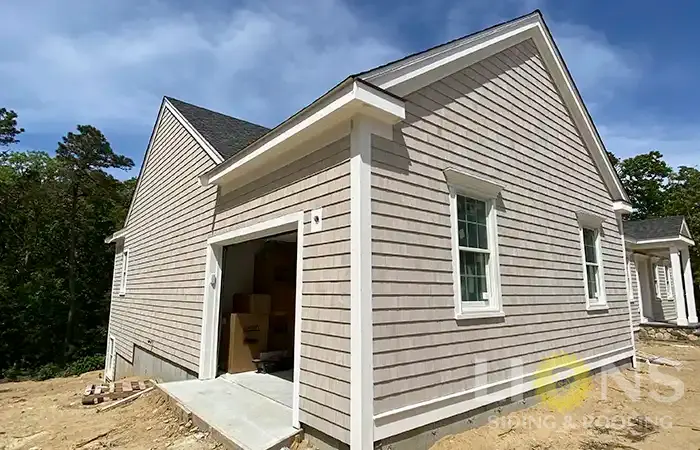
Scituate, MA, has a relationship with nor’easters that no other South Shore town can match. The harbor town has been broadcast in national news during multiple major storm events, boats floating in the streets of Scituate Harbor, Humarock Beach underwater, and Egypt Beach barriers overwhelmed. This is not a new phenomenon. It is the defining characteristic of living in one of New England’s most weather-exposed coastal communities.
For Scituate homeowners, the practical consequence of this storm history is an exterior that ages faster, fails earlier, and costs more to maintain than in most of eastern Massachusetts. Vinyl siding was blown off in a January nor’easter. Cedar shingles are rotting at the base from repeated storm surge splash. Trim boards are turning black with mold within months of installation. These are not surprises to any contractor who has worked extensively in Scituate; they are the predictable outcomes of building to average coastal standards in a far-above-average coastal exposure environment.
At Lions Siding & Roofing, we have taken on siding projects across Scituate’s neighborhoods, from the Harbor area to North Scituate, Greenbush to Humarock. What we find consistently is that the only siding that truly performs in Scituate is engineered for coastal performance, not just marketed for it. This guide explains the difference, the data behind it, and how to make the right decision for your home.
Why Scituate Siding Fails at a Rate Unlike Any Other South Shore Town
Three geographic factors combine to make Scituate uniquely demanding for exterior siding systems:
- Open Atlantic Exposure: Unlike Marshfield and Plymouth to the south, Scituate’s coastline faces northeast, directly into the dominant nor’easter track. There is no Cape Cod peninsula to absorb or deflect storm energy before it reaches Scituate’s exterior walls. Homes at the Harbor, along Oceanside Drive, and in the Humarock and Egypt Beach neighborhoods face the full kinetic force of Atlantic storms.
- Storm Surge + Wind-Driven Rain Combination: The feature that makes Scituate’s storm damage uniquely severe is the combination of low-lying coastal geography and wind-driven horizontal rain. During major nor’easters, wind-driven rain impacts Scituate siding at velocities that exceed what standard water-resistance ratings are designed for. Any weakness in a lapped joint, corner board transition, or window flashing becomes a water infiltration point.
- Year-Round Salt Spray: Even between storm events, Scituate’s proximity to the Atlantic means constant salt chloride deposition on exterior surfaces. Salt is hygroscopic; it attracts and holds moisture, meaning siding in Scituate stays wetter longer than in inland markets, dramatically accelerating any rot, mold, or corrosion process that has a foothold on the surface.
The Nor’easter Pattern: What Four Decades of Harbor Flooding Teach Us About Exterior Walls
Scituate has been struck by significant nor’easters in 1978, 1991, 1993, 1997, 2007, 2013, 2018, and 2022. Each event has been documented with sustained wind speeds of 45–75 mph and storm surge of 3–8 feet above normal tide at the harbor. The damage to Scituate homes in these events is well-photographed, but the more important story is what happens between the named storms.
Repetitive stress is what destroys Scituate siding systems. Each winter season delivers 8–15 significant wind and rain events that don’t make the news but quietly fatigue every lapped joint, every caulk bead, and every fastener in the exterior envelope. After 10 years, a standard vinyl siding system in Scituate shows the cumulative effects of 80–150 high-wind events on its fastening pattern. After 15 years, corner boards and window surrounds have been stressed enough that water infiltration is essentially inevitable.
Homeowners on the South Shore often ask how their storm exposure compares to coastal Cape Cod towns. Our Eastham Siding Replacement guide covers the same engineering principles for Outer Cape exposure environments; the wind physics and salt chloride challenges are nearly identical to Scituate’s harbor-facing neighborhoods.
Field Report: What Scituate Siding Inspections Reveal After Every Storm Season
Based on Lions Siding & Roofing’s project history and post-storm assessments across Scituate:
- The Vinyl Failure Threshold: In Scituate’s full-exposure zones (Harbor area, Oceanside Drive, Humarock, Egypt Beach), vinyl siding shows significant brittleness and panel cracking by year 12–15, roughly half its rated lifecycle. Standard warranty claims are frequently denied because storm-caused cracking is classified as a wind damage event rather than a product defect.
- The Corner Board Epidemic: Over 75% of Scituate homes we inspect with vinyl siding systems have failed corner boards within 10 years of installation. Corner boards are the leading edge of the system, the first point hit by wind-driven rain. When a corner board fails, water enters the wall cavity at the highest-priority infiltration point.
- The Trim Rot Cycle: Cedar and pine trim boards in Scituate have an effective functional life of 6–8 years at grade level and 10–12 years at upper floors. Without annual paint maintenance, Scituate’s humidity and salt environment accelerates rot to the point where trim replacement becomes a rolling annual budget item rather than a capital expense.
- The Insurance Pattern: Following major nor’easters, Scituate homeowners with vinyl siding systems file insurance claims at 2–3x the rate of homeowners with fiber cement siding, based on Plymouth County insurance industry data. The differential claim rate drives premium increases across the town.
- The Re-Side Interval: The average siding replacement interval for Scituate coastal homes is 18–22 years, 8–12 years shorter than the 30-year lifecycle warranted by most vinyl products. This gap represents a substantial difference in the total cost of ownership over 35 years.
The Right Siding System for a Scituate Home
The design criteria for a Scituate siding replacement are more demanding than for an inland Massachusetts home. Four areas require specific attention:
- Impact resistance: Scituate’s storm history includes debris-driven impact events, small objects carried by high winds that hit siding with enough force to penetrate vinyl panels. Fiber cement siding at 5/16” thickness (versus 3/32” for vinyl) does not crack or penetrate under most impact scenarios, including minor flying debris common in nor’easters.
- Water management: Every Scituate siding project we execute includes a Weather-Resistive Barrier (WRB) upgrade beneath the new siding. We specify Zip System sheathing or high-performance housewrap with fully taped seams and properly integrated window flashing to create a secondary water management plane that stops infiltration even when wind-driven rain finds its way behind siding panels.
- Thermal performance: Scituate homes with original insulation typically have R-11 or lower wall assemblies. During a siding replacement, we offer continuous exterior rigid foam insulation (R-5 or R-10) that improves whole-wall thermal performance significantly without interior disruption, a high-value addition during a project that has already exposed the sheathing layer.
- Fastening: All siding panels are face-nailed with corrosion-resistant stainless steel or hot-dipped galvanized nails. In Scituate’s salt air environment, standard zinc-coated fasteners corrode within 3–5 years and become system failure points as siding panels pull away from loosened fasteners under wind load.
Premium Integration: James Hardie HZ10 + Azek PVC Trim
James Hardie HardiePlank lap siding and HardiePanel with HZ10 formulation is what we specify most often for Scituate full-exposure projects. HZ10 is Hardie’s coastal climate formulation, engineered specifically for high-humidity, salt-spray environments, and it performs fundamentally differently from standard fiber cement products:
- HZ10’s denser cement matrix resists moisture absorption, directly addressing Scituate’s “stays wet longer” problem, driven by constant salt chloride deposition and nor’easter splash.
- ColorPlus factory finish technology bakes color directly into the panel surface, providing fade and chalk resistance that outlasts field-applied paint by a significant margin in UV and salt spray environments. In Scituate, this eliminates the 5–7 year exterior repaint cycle that burdens homeowners with wood siding systems.
- James Hardie fiber cement does not crack, rot, or support mold growth, the three most common failure modes we document in Scituate siding replacements, regardless of original product type.
For all trim, corner boards, window surrounds, fascia, frieze boards, and sill aprons, we specify Azek PVC trim. In Scituate, Azek trim is not a luxury upgrade. It is a functional requirement. Azek does not absorb water, does not rot, and does not require periodic repainting to maintain its structural integrity. For a Scituate homeowner, Azek trim eliminates the rolling annual trim maintenance budget that is an unavoidable feature of wood trim systems in this climate.
The combination of James Hardie HZ10 siding with Azek PVC trim creates what we call the zero-maintenance exterior envelope for Scituate homes. The system requires washing and periodic inspection, but eliminates paint cycles, rot remediation, and storm-damage vulnerability from your ownership cost structure. It is the same exterior philosophy we apply to high-exposure Cape Cod homes, brought directly to the South Shore.
All Lions Siding & Roofing projects in Scituate are permitted through the Scituate Building Department and managed under CSL 120645 / HIC 198901.
Frequently Asked Questions (FAQ)
Is fiber cement siding worth the higher cost in Scituate?
The installation cost of James Hardie is 30–50% higher than that of vinyl. But in Scituate’s exposure environment, the total cost of ownership tells a different story. Vinyl requires replacement every 18–22 years in Scituate coastal zones; Hardie carries a 30-year product warranty and typically performs well beyond that timeline. The labor cost of replacement is the same event both times, meaning you pay it once with Hardie versus twice with vinyl over a 35-year ownership period.
Can I keep my existing trim and just replace the siding?
We assess this on a project-by-project basis. In Scituate homes more than 20 years old, trim and siding are almost always in comparable condition. Mixing new Hardie siding with existing wood trim creates a maintenance mismatch where the trim fails first and requires re-work while the siding is still new. In most cases, replacing both simultaneously produces a better long-term outcome and a lower 10-year total cost.
How does a siding replacement affect my Scituate home’s resale value?
James Hardie siding consistently delivers one of the highest ROI ratings of any exterior home improvement in the Northeast, with Remodeler Magazine’s annual Cost vs. Value Report placing fiber cement siding at 76–82% ROI nationally. In the South Shore market, where buyers are increasingly educated about the ongoing maintenance cost of coastal exterior systems, the premium for a newly sided home with Hardie and Azek trim typically exceeds the national average.
Do you work in all of Scituate’s neighborhoods?
Yes. Our crews work throughout Scituate, the Harbor area, Humarock, Egypt Beach, North Scituate, Greenbush, Mann Hill, Minot, and all neighborhoods in between. Every project is supervised on-site by a full-time Lions Siding & Roofing field manager.
How do I prepare my home for a siding replacement?
Our team handles all exterior prep, removal of shutters, light fixtures, satellite dishes, and surface-mounted items. We ask that you clear a 10-foot perimeter around the home on the ground and ensure access to an outdoor electrical outlet. We handle all material delivery, dumpster placement, and daily site cleanup, including ground magnetic sweeps for stray fasteners.
Does Lions Siding & Roofing pull permits for siding in Scituate?
Yes. Scituate requires a building permit for full siding replacements. We file the permit with the Scituate Building Department and coordinate all required inspections under our Massachusetts licenses (CSL 120645 / HIC 198901). The permitting timeline is factored into your project schedule at the outset, so there are no delays once materials arrive.
Scituate has earned its reputation as the South Shore’s most weather-tested town. Your home’s exterior should be built to match that standard, not designed for average coastal exposure, but engineered for Scituate’s specific, documented, repeat-storm environment. Request a Free Project Review at (774) 338-6234 or visit roofinglions.com to schedule your complimentary Scituate siding consultation.